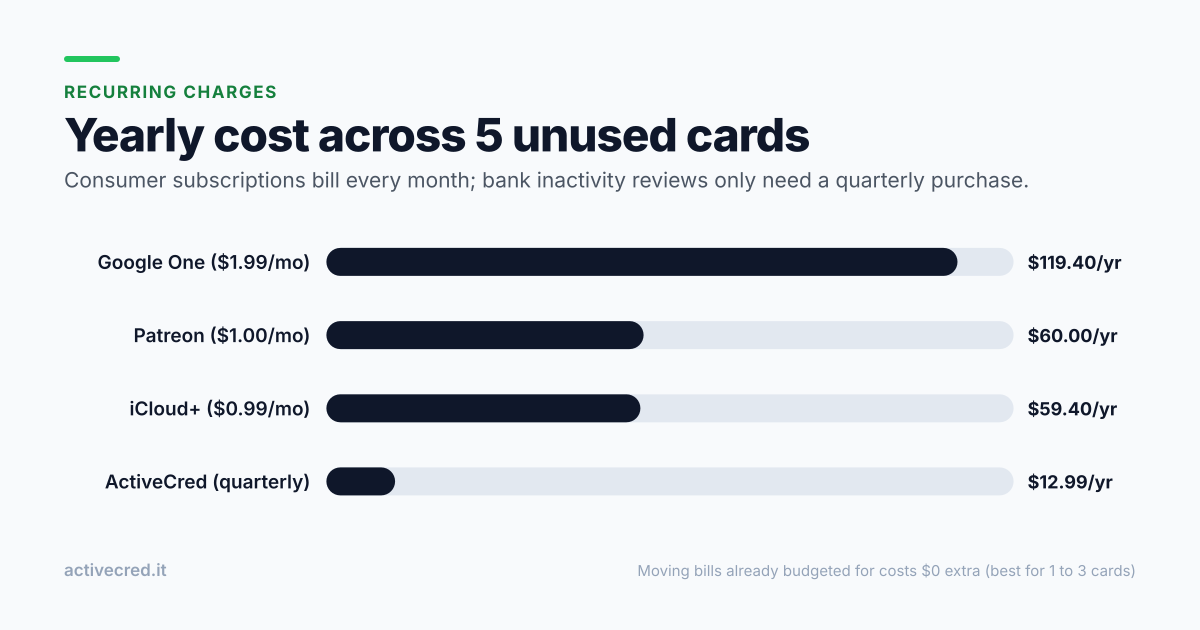
Cardholders looking for a small recurring charge to keep an unused credit card open usually fall into one of two situations. Moving an existing subscription onto one or two idle cards costs nothing extra and works reliably when paired with full-statement autopay. Signing up for new $0.99 or $1.99 monthly subscriptions solely to generate activity across five or ten sock-drawer cards is a different equation: because consumer subscriptions bill every month rather than once a quarter, a "$1 monthly bill" adds up to $12 a year per card.
First assign bills already paid for ($0 extra). Once unused cards outnumber household subscriptions, quarterly charges cost far less than new monthly plans: 5 cards cost $12.99/yr on ActiveCred ($2.99 plan plus $0.50 quarterly charges), against $59.40/yr for five $0.99/mo subscriptions.
Compare 5 services or try the demoRule 1: assign existing bills before buying anything new
Most households already pay three to six recurring monthly bills that accept any open-loop credit card without a surcharge: streaming music or video, cloud storage, password managers, news subscriptions or gym memberships. Putting one existing bill on each unused card and turning on full-statement autopay at the bank keeps a transaction posting every 30 days at $0 net cost.
Two checks keep that setup clean. First, make sure the bill does not forfeit a major rewards multiplier or cell-phone protection benefit that belonged on another card (for example, wireless bills often carry cell-phone insurance only when paid on a specific card). Second, update the merchant whenever the bank reissues an expiring or compromised card, since a silent billing failure stops activity.
Every common low-dollar recurring charge compared
When a cardholder holds six, ten or fifteen downgraded no-fee cards and runs out of existing bills to spread around, these are the recurring charges most often suggested on credit forums, along with their real yearly math and account limits:
| Recurring option | Minimum price & cadence | Yearly out-of-pocket (1 card / 5 cards) | Multi-card catch |
|---|---|---|---|
| Existing streaming / software bill | Already budgeted, monthly | $0 extra / $0 extra | Limited by how many bills a household already pays |
| Apple iCloud+ (50 GB) | $0.99/mo + tax | $11.88 / $59.40 | One primary card per Apple Account; cannot split across 5 cards |
| Google One Basic (100 GB) | $1.99/mo + tax | $23.88 / $119.40 | One primary card per Google Payments profile |
| Patreon creator membership | $1.00/mo + tax | $12.00 / $60.00 | Allows per-membership cards; creators occasionally pause billing |
| Monthly charity or Wikipedia pledge | $1.50 to $5.00/mo | $18.00+ / $90.00+ | Many forms require $2 to $5 minimums; may add donor mail |
| Amazon Auto-Reload | $5.00/mo minimum | $60.00 / $300.00 (gift credit) | $5 floor since July 2024; monthly-only Auto-Reload |
| ActiveCred scheduled charge | $0.50/charge (quarterly default) + $0.99 to $4.99/yr plan | $2.99 / $12.99 | Covers 1 to 20 US cards in one dashboard; decline alerts included |
Why quarterly cadence beats monthly subscriptions by 4x
Consumer SaaS and creator platforms bill every month because their products are delivered monthly. A bank's inactivity review has no monthly requirement: the shortest closure reported at a major US issuer is 10 to 12 months at Wells Fargo, followed by 12 months at American Express, Chase, U.S. Bank and Synchrony, and two years or more at Bank of America, Capital One and Citi.
Charging a card 12 times a year when 4 times a year clears every reported bank triples the number of statements to pay and quadruples the annual spend. Even at banks that apply small-balance statement waivers of up to $1.00 or $2.00, cardholders who want an ordinary statement bill drafted by autopay can set a quarterly charge to any preferred amount on a single schedule rather than managing ten separate vendor logins.
Comparing dedicated card-activity services
Five services exist specifically to put small scheduled charges on unused US credit cards: ActiveCred, Credicated, Keep My Credit Card, Recurring Transaction and KeepCreditCardOpen. Recurring Transaction bills monthly only ($1.49/mo, or $17.88/yr per card), while KeepCreditCardOpen offers yearly ($0.99/yr) and monthly ($11.88/yr) tiers without a quarterly schedule. At one charge a quarter, ActiveCred costs $2.99/yr for 1 card, $12.99/yr for 5 cards, and $44.99/yr for 20 cards, the lowest total across all five services at that cadence (full 5-service calculator).
How recurring activity protects the credit file
Every open card contributes its credit limit to the denominator of revolving utilization inside amounts owed (30% of a FICO score) and continues aging on the report inside length of credit history (15% of a FICO score). When a bank closes an idle card, its credit limit disappears on the next reporting cycle, while the closed tradeline stays on the report for up to ten years before dropping off and removing its age. Putting one small recurring charge on each card, coupled with full-statement autopay, keeps every line active with minimal effort.