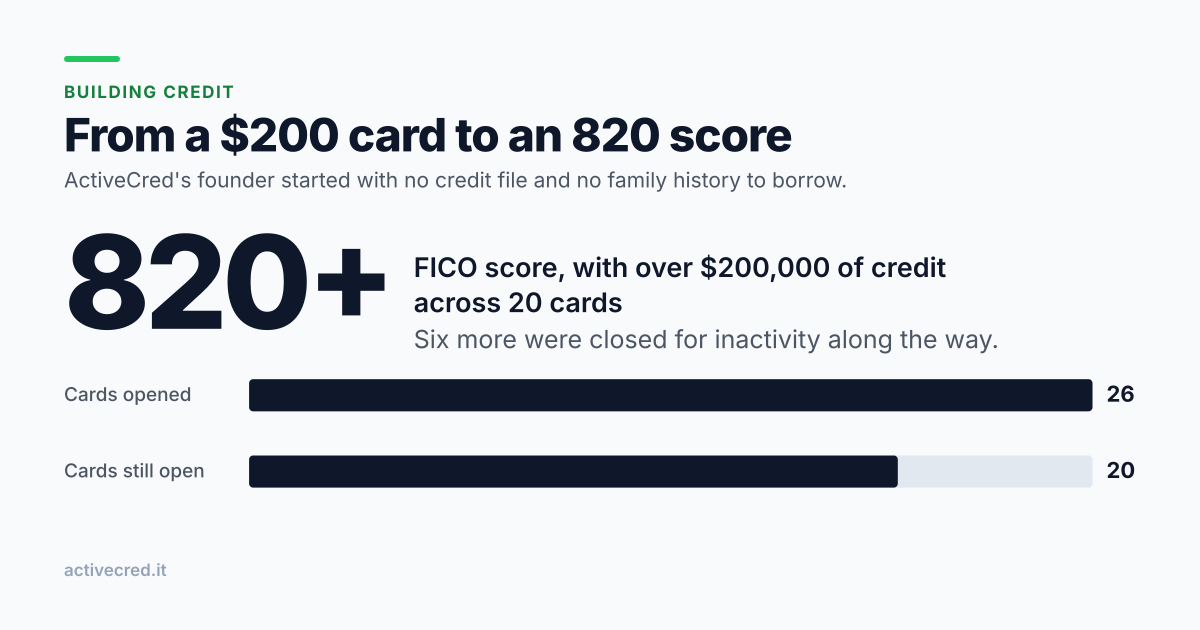
ActiveCred's founder started where many first-generation Americans start, with no credit file at all and no parent whose history could be borrowed. The first card had a $200 limit. Now 30, the founder holds 20 cards with more than $200,000 of credit between them and a FICO score above 820. There should have been 26. Six cards were closed by their banks for lack of use, and took years of history with them; age is now the weakest part of the file.
The method is unglamorous: one small first card, every payment on time, balances kept low, limits grown slowly, and every card kept open. Payment history (35% of a FICO score) and amounts owed (30%) do most of the work; length of credit history (15%) is what inactivity closures damage. ActiveCred prevents those closures with a small scheduled charge.
Keep every card open or jump to pricingStarting with no file
Having no credit history is not the same as having bad credit, but to a lender it can look similar. The Consumer Financial Protection Bureau has estimated that about 26 million American adults had no credit record at all, and that a further 19 million had too little history to be scored. A first-generation American often starts there for an obvious reason: a parent who arrived with no American credit history has none to share.
FICO will not produce a score until the file meets its minimum: at least one account open for six months or more, and at least one reported to the bureaus in the past six months. The first task, then, is simply to get one account and let it age. Everything else follows from that account's record.
The first card: small and boring
The founder's first card had a $200 limit. That is typical of a first card for someone with no file, and usually means a secured card, where a cash deposit sets the limit, or a starter card from a bank willing to take a small risk. Either kind reports to the bureaus like any other card, which is the only thing that matters at this stage.
A $200 limit makes utilization a live issue from the first purchase. A $60 balance is 30% of the limit; a $150 one is 75%. The balance the bank reports is usually the one on the statement, so paying most of it down before the statement closes keeps the reported figure low even when the card is used. Paying the statement in full avoids interest altogether.
Secured cards come with a second reason to use them steadily. Many are reviewed for an upgrade to an unsecured card, with the deposit returned; Discover describes automatic reviews from month seven. A secured card left idle gives that review nothing to go on, and can be closed like any other card.
The shortcut that was not available
The quickest way to add years to a thin file is to be added as an authorized user on a relative's old, well-kept card. The account's history then appears on the new user's report. FICO says such accounts can affect a score, with less weight than accounts held in one's own name in recent versions of the model.
A first-generation American often has no such relative, and the founder did not. For those who do, it is worth asking for. For those who do not, the route is slower but not different in kind: one account, then another, each with a clean record.
What FICO weighs, and how each part was built
FICO groups what it reads into five factors, according to FICO's published weights. Each was built differently.
- Payment history, 35%. The largest factor, and the simplest. Autopay set to at least the minimum on every card removes the risk of a missed payment; a late payment can stay on a report for seven years.
- Amounts owed, 30%. Mostly utilization: balances divided by limits, overall and card by card. It gets easier as limits grow. A $150 balance is 75% of a $200 limit and less than a tenth of 1% of $200,000.
- Length of credit history, 15%. The age of the oldest account and the average age of all of them. This is the founder's weakest factor, and it could not be otherwise: twenty cards opened by the age of 30 means many young accounts, and each new card pulls the average down.
- New credit, 10%. Recent applications and new accounts. A hard inquiry counts in FICO scores for a year and stays on the report for two, which is the argument for spacing applications out.
- Credit mix, 10%. Having both revolving accounts, such as cards, and installment loans. It is the smallest factor, and not a reason to borrow.
Growing the limits
That increase comes from three sources. The first is the existing cards. A secured card graduates, banks grant automatic increases to accounts with a good record, and the cardholder asks for more. Some banks consider a request without a hard inquiry; asking which kind of check it will be, before agreeing, costs nothing.
The second is new cards, added one at a time with gaps between them. Each brings a new limit and a hard inquiry, and each lowers the average age of accounts. That trade is visible in the founder's file: a very high total limit and a short average age.
The third source is the one most guides leave out: not losing the limits already won. A card closed for inactivity takes its limit with it.
The six cards that closed
Six of the founder's cards were closed by their banks for going unused. That is the gap between 26 accounts and 20. None was closed for a missed payment or a high balance; each simply sat in a drawer past its bank's window.
How long a card can sit
Banks do not publish those windows. The closures cardholders have reported run from about 10 to 12 months at Wells Fargo to two years or more at Bank of America, Capital One and Citi, according to the issuer-by-issuer record. A card opened for one purpose, a sign-up bonus or a store discount, and then forgotten will pass through the shortest of them in under a year.
What the closures cost
The cost came in two parts. The limits left the utilization calculation at once. The age is slower: a closed account in good standing stays on the report, and keeps counting toward the average age of accounts, for up to ten years, according to Experian. Then it drops off, and the average falls. For a file whose weakest factor is already its age, six old accounts dropping off over the next decade is the cost still to come.
The method, in order
- One card. A secured or starter card, used for something small each month.
- Every payment on time. Autopay for at least the minimum, from the first statement.
- Low statement balances. Pay down before the statement closes, and in full after it.
- Wait. Six months before FICO will score the file; a year before a second card is worth applying for.
- Grow the limits. Graduation, automatic increases, requests, and new cards with gaps between them.
- Keep every card open. One purchase every three months on each, which clears the shortest reported closure with seven months to spare.
In short
Building credit from nothing takes no trick: a small first card, years of on-time payments and low balances, and limits that grow as the record does. The part that is easiest to lose is the part that takes longest to build. Six closed cards are the founder's measure of it, and the reason ActiveCred exists.