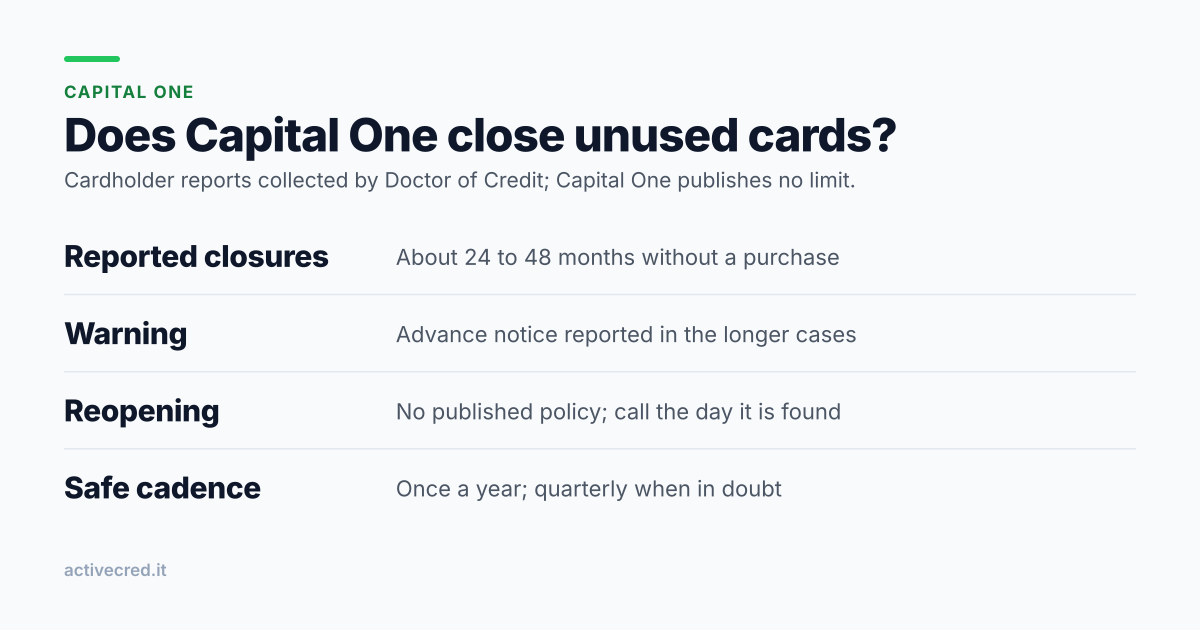
Capital One closes credit cards that go unused, but it is among the slowest of the large banks to do so. It publishes no limit, and cardholders report closures after two to four years without a purchase, often with notice first. The exception, in one report, is the expiry date: a card that reached it unused was not replaced. One purchase a year keeps a Capital One card inside every report.
Capital One is reported to close unused cards after about 24 to 48 months, with notice in the longer cases. No reopening policy is published, so a closed card is worth a call the day it is found. ActiveCred charges each Capital One card once a year by default.
Keep a Capital One card open or jump to pricingWhat the record shows
The figures come from the closures cardholders have reported, collected by Doctor of Credit and kept by ActiveCred, with sources, in a public data file checked on November 14, 2026. They are reports, not policy.
Older reports describe Capital One leaving cards open for three to four years before closing them, with advance notice. More recent ones describe closures at "2 years or less", without a shorter figure. One reader describes a different route. The card reached its expiry date unused, Capital One declined to send a replacement, and the account closed on the date printed on the card.
Read together, the reports put the shortest Capital One figure at about 24 months, against about 10 to 12 months at Wells Fargo and about 12 at American Express and Chase. "Or less" is the reason to treat two years as an outer bound, not a safe date. The issuer-by-issuer record sets out the rest.
What "dormant" means at Capital One
People search for a "dormant Capital One card", but Capital One does not define the word for credit cards. What matters is inactivity, the time since the last purchase that posted to the statement. Payments, refunds and logging in to the app do not count. Only a posted purchase resets the clock.
"Dormant" has a legal meaning for bank accounts that hold the customer's money. A Capital One 360 checking or savings account left untouched for years can, under state unclaimed-property law, have its balance passed to the state. That is a separate process from a card closure, and the difference between inactive and dormant explains it.
Is there a warning first?
Sometimes. Advance notice is reported in the longer Capital One cases, where closures came after three to four years. The card closed at expiry came with no reported warning beyond the absence of a new card in the mail.
No law requires one. Regulation B, which makes lenders explain adverse decisions, excludes actions taken because of inactivity. A notice, where one comes, goes to the address on file, and a cardholder who has moved since last using the card may never see it. The notice record across banks shows how uneven the practice is.
How to reopen a closed Capital One card
Capital One publishes no reopening policy, and the cardholder reports do not cover it. The general record is that reopening is most likely soon after an inactivity closure, on an account in good standing, so the call is worth making the day the closure is found.
- Call the number on the back of the card or Capital One's general card line, and say that the card was closed for inactivity.
- Ask whether it can be reopened as the same account. A reopened account keeps its opening date and history; a new card does not.
- Ask whether there will be a credit check, and whether the limit will be the same, before agreeing.
If Capital One says no, the remaining route is a new application. Capital One offers a pre-approval check on its website that it says has no impact on a credit score. The application itself brings a hard inquiry and a new account with a new opening date. The closed account stays on the credit report for up to ten years if it was in good standing, according to Experian, and keeps counting toward the average age of accounts until it drops off.
What happens to Capital One rewards
ActiveCred has found no published grace period for Capital One rewards after a closure, and the program's terms should be read before relying on one. Miles and cash back are safest redeemed or moved before a card goes idle. A cardholder with a second Capital One card that earns the same rewards may be able to combine balances; the rewards guide covers what other programs do.
Fee-paying cards such as the Venture ($95) and Venture X ($395) are the least exposed. The annual fee posts each year and appears to count as activity, and Doctor of Credit's summary is that cards with annual fees are not closed for inactivity. The no-fee Quicksilver, Savor and Platinum cards are the ones to watch.
Checking a Capital One card that has sat unused
The quickest test is a small purchase. If a $1 charge goes through and posts, the card is open and its clock has just been reset. If it is declined, the account may have been closed, or the bank's fraud checks may want to confirm the purchase; a large or unusual charge after months of silence can be refused while the account stays open. Capital One's app or website shows a closed account as closed, or drops it from the list.
The credit report settles whether the account is open. Reports from all three bureaus are free every week at annualcreditreport.com, and an account the bank has closed carries a remark such as "closed by credit grantor". The date of the last purchase is on the statements. Five ways to check a card sets out the rest.
The safe cadence
ActiveCred's rule is a cadence no longer than half the shortest reported closure, and never less often than once a year. Half of Capital One's 24 months is 12, so a newly linked Capital One card is charged once a year unless the cardholder picks another schedule. No card is charged less often.
Given the "or less" in the recent reports, a cardholder may prefer every three months. It is the schedule ActiveCred gives a card from a bank with no reports, and it clears the shortest closure reported at any large bank, about 10 months at Wells Fargo, with seven months to spare.
For a card whose last purchase date is known, the inactivity checker, set to Capital One shows how far into the reported window it is and the date to use it by.
In short
Capital One is patient with unused cards. On the record cardholders have assembled, it waits about two years at the shortest, often with notice. Its patience can end at the expiry date, where one unused card was simply not replaced.