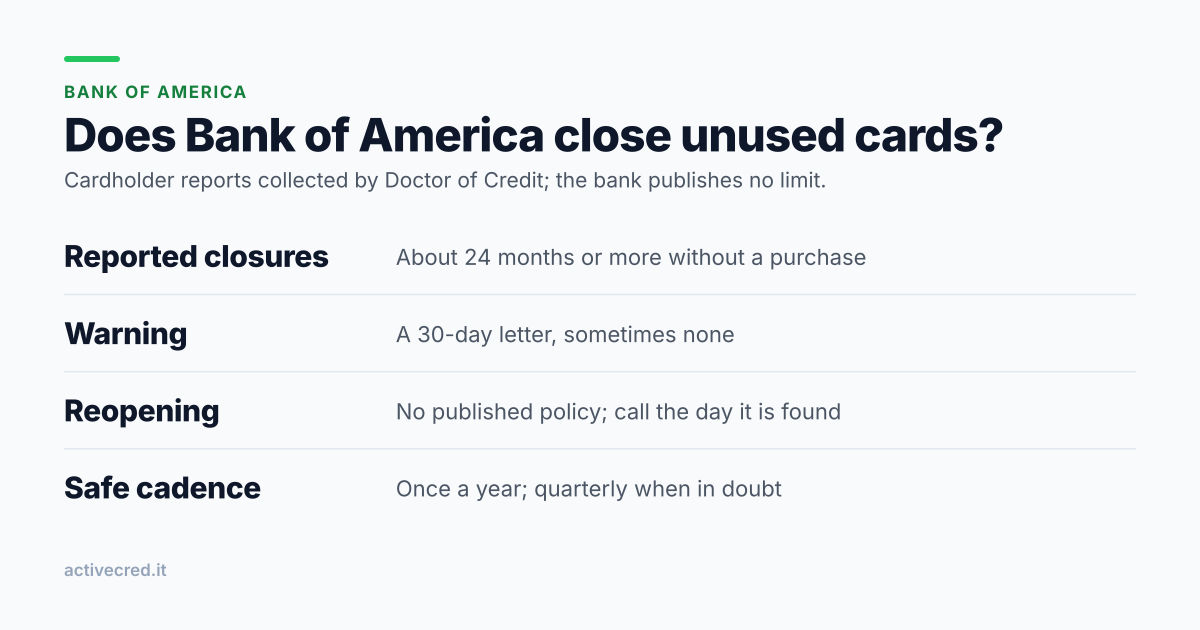
Bank of America closes credit cards that go unused, but not at six months, as this Journal and much of the web once said. Cardholders report closures after about two years without a purchase. Some received a letter giving 30 days; others were closed later with no warning at all. One purchase a year keeps a Bank of America card inside every report.
Bank of America is reported to close unused cards after about 24 months or more. Some cardholders received a letter giving 30 days to use the card; others were closed after a few years with no warning. No reopening policy is published. One purchase a year clears every report, and ActiveCred makes it, with a small charge on each linked card on a schedule the cardholder sets.
See how ActiveCred keeps a Bank of America card open or jump to pricingWhat the record shows
The figures come from closures cardholders have reported, collected by Doctor of Credit and kept by ActiveCred in a public data file checked on November 14, 2026. They are reports, not Bank of America policy.
The most specific report describes a letter, sent at about two years of inactivity, giving 30 days to use the card before it would be closed. Other cardholders describe closures after a few years with no letter at all. Together, the reports run from about 24 to 36 months. That puts Bank of America among the slower large banks, alongside Capital One and Citi. The issuer-by-issuer record has the comparison.
The record has limits. Doctor of Credit's list dates from 2019, with reader reports added since, and several entries rest on a single account. A bank can also change its practice without announcing it. The figures are the best public record, not a promise, and that is the case for leaving a margin. At Bank of America, where some closures came with no letter at all, the margin is the only warning a cardholder controls.
The six-month myth
Until November 2026, this Journal said Bank of America and Citi close unused cards at six to 12 months. Many other sites said the same, none with a source. When the reports were checked, Bank of America came in at about 24 months and Citi at 25 or more, and the Journal was corrected. The editorial policy explains how figures are now sourced.
The banks that need closer watching are the quicker ones. Wells Fargo is reported at about 10 to 12 months, and American Express and Chase from about 12.
A letter, sometimes
A 30-day letter is a useful warning when it arrives. It is dated, specific and long enough to act on. The reports show it does not always arrive, and no law requires it. Regulation B excludes actions taken because of inactivity from the rules that make lenders explain adverse decisions.
The letter goes to the address on file. For a card unused for two years, that address may be out of date. What other banks send is no more reliable.
Limit cuts before closures
Closure is not the only thing that happens to an idle card. Doctor of Credit notes that cuts to credit limits on inactive cards are even more common than closures. A lower limit on an unused Bank of America card, in the app or on a statement, is a sign the account is being reviewed, and it raises utilization on every card the cardholder holds.
The response is the same as to a warning letter: a purchase that day, and a request for the old limit once it has posted.
If the card has already closed
Bank of America publishes no reopening policy, and the cardholder reports do not cover it. The general record is that reopening is most likely soon after an inactivity closure. Call at once, say the card was closed for inactivity, and ask whether it can be reopened as the same account, whether there will be a credit check, and whether the limit will be the same.
Rewards deserve the same urgency. ActiveCred has found no published grace period for Bank of America rewards after a closure, so cash rewards and points are best redeemed before a card goes idle, and at once if it has closed. The rewards guide compares the programs.
Checking a Bank of America card that has sat unused
The quickest test is a small purchase. If a $1 charge goes through and posts, the card is open and its clock has just been reset. If it is declined, the account may have been closed, or the bank's fraud checks may want to confirm the purchase. A large or unusual charge after months of silence can be refused while the account stays open. Bank of America's app or website will show a closed account as closed, or drop it from the list.
The credit report settles it. Reports from all three bureaus are free every week at annualcreditreport.com, and an account the bank has closed carries a remark such as "closed by credit grantor". The date on the report is that of the last update, not of the last purchase, which only the statements show. Five ways to check a card sets out the rest.
At Bank of America, as at every bank, only a purchase that posts to the statement counts as use. Payments, refunds and logging in do not reset the clock, and a balance transfer is not a purchase. What counts as activity has the detail.
The safe cadence
ActiveCred sets a cadence no longer than half the shortest reported closure, and quarterly when in doubt. Half of Bank of America's shortest report is about 12 months, so ActiveCred's smart cadence charges a Bank of America card once a year, the least often it charges any card.
Quarterly is the default because it clears the shortest closure reported at any large bank, about 10 months at Wells Fargo, with seven months to spare. One rhythm then covers every card in the wallet, whichever bank issued it. A cardholder with cards from several banks should plan around the shortest window among them, not the longest.
The Premium Rewards card ($95) posts a fee each year, which appears to count as activity. The no-fee Customized Cash, Unlimited Cash and Travel Rewards cards are the ones that need a purchase. For a card whose last purchase date is known, the inactivity checker, set to Bank of America shows how far into the reported window it is and the date to use it by.
In short
Bank of America is not the six-month closer of folklore. It is reported at about two years or more, sometimes with a 30-day letter and sometimes with none. A purchase a year keeps a Bank of America card inside every report; a purchase every quarter does the same for every card in the wallet.