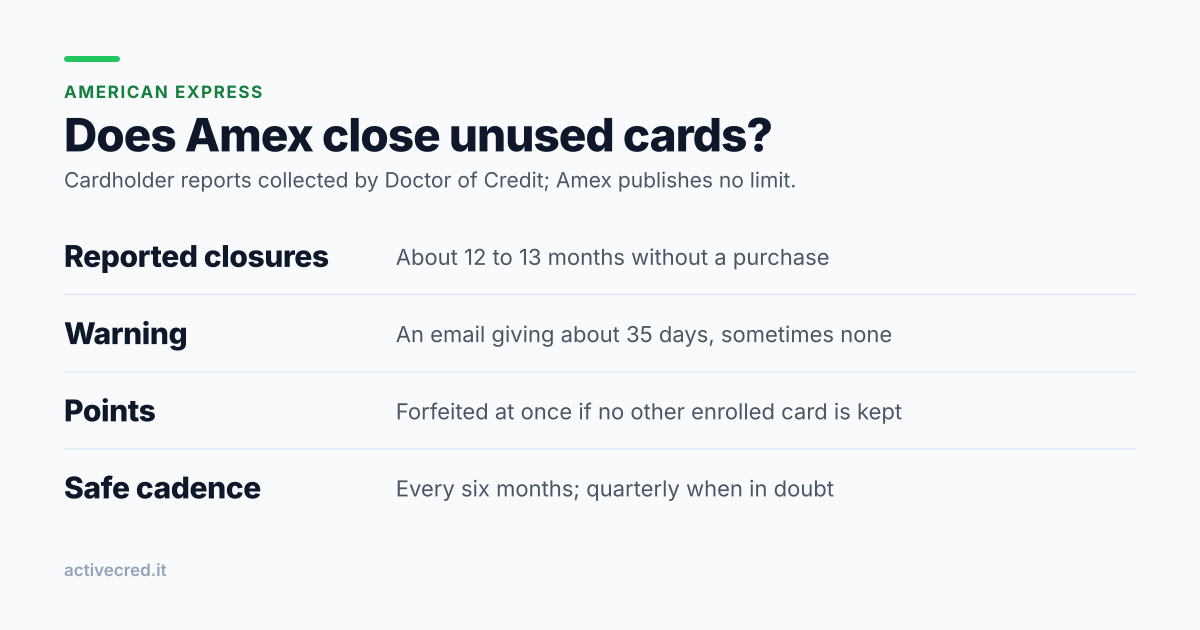
American Express closes credit cards that go unused, and sooner than most large banks. Cardholders report closures at about 12 to 13 months without a purchase, sometimes after an email giving about 35 days to use the card. Fee-paying cards are rarely affected. The risk sits with the no-fee cards and the points on them, and a purchase every six months keeps them inside every Amex report.
Amex is reported to close unused cards at about 12 to 13 months, sometimes after an email giving about 35 days to use the card. Gold and Platinum cards are rarely closed, because the fee posts each year. Membership Rewards points are forfeited at once if no other enrolled card is kept. Each no-fee Amex card needs a purchase at least every six months, and ActiveCred makes it, with a small charge on each linked card on a schedule the cardholder sets.
See how ActiveCred keeps an Amex card open or jump to pricingWhat the record shows
The figures come from closures cardholders have reported, collected by Doctor of Credit and kept by ActiveCred in a public data file checked on November 14, 2026. They are reports, not Amex policy.
One cardholder reports a closure at about 12 to 13 months with no warning. Several others report an email that gave about 35 days to use the card before it would be closed, and Doctor of Credit describes that email as the official word from Amex. The reported range is narrow, at 12 to 13 months. Among the large banks, only Wells Fargo, at about 10 to 12 months, is reported shorter. The issuer-by-issuer record has the comparison.
The record has limits. Doctor of Credit's list dates from 2019, with reader reports added since, and several entries rest on a single account. A bank can also change its practice without announcing it. The figures are the best public record, not a promise, and that is the case for leaving a margin. At Amex, where the shortest report is about a year, the margin matters more than at most banks.
The 35-day email
Where the email arrives, it is the most useful warning any bank is reported to send. It is specific, dated and long enough to act on. A single purchase that posts before the date keeps the card.
It is still not guaranteed. Regulation B excludes actions taken because of inactivity from the rules that require lenders to explain adverse decisions, so Amex owes no notice, and at least one cardholder received none. An old email address, or a filter that files Amex mail with marketing, means the warning is never read. What other banks send is more uneven still.
Membership Rewards points
American Express says that points are forfeited immediately when the last enrolled card is cancelled, unless the cardholder keeps another card in the program. There is a newer complication. Some recently opened cards have their own rewards account, so a second Amex card does not automatically protect the points on the first.
The exposure is a no-fee card that earns points and then goes idle. The 35-day email, if it comes, is the moment to move the points or use the card. The rewards guide compares Amex with Chase, Citi and the others.
Which Amex cards are at risk
The fee-paying cards are the safe ones. The Platinum ($895), Gold ($325), Green ($150) and Blue Cash Preferred ($95) each post an annual fee, which appears to count as activity. Doctor of Credit's summary is that cards with annual fees are not closed for inactivity. The same is true of co-branded fee cards such as the Delta SkyMiles Gold and Hilton Honors Surpass cards.
The risk sits with the no-fee cards, such as the Blue Cash Everyday, and with any card downgraded to a no-fee version to save the fee. A downgrade that keeps the account's age is a sound move. But the card then needs a purchase, because the fee no longer protects it.
If the card has already closed
Amex publishes no reopening policy, and the cardholder reports do not cover reopening after a closure. The general record is that reopening is most likely soon after an inactivity closure. Call at once, say the card was closed for inactivity, and ask whether it can be reopened as the same account, whether there will be a credit check, and whether any points can be restored with it.
If not, a new application is the route back, with a hard inquiry and a new account. Some Amex welcome offers are limited to customers who have not held the card before, which can make a second application less rewarding than the first.
Checking an American Express card that has sat unused
The quickest test is a small purchase. If a $1 charge goes through and posts, the card is open and its clock has just been reset. If it is declined, the account may have been closed, or the bank's fraud checks may want to confirm the purchase. A large or unusual charge after months of silence can be refused while the account stays open. American Express's app or website will show a closed account as closed, or drop it from the list.
The credit report settles it. Reports from all three bureaus are free every week at annualcreditreport.com, and an account the bank has closed carries a remark such as "closed by credit grantor". The date on the report is that of the last update, not of the last purchase, which only the statements show. Five ways to check a card sets out the rest.
At American Express, as at every bank, only a purchase that posts to the statement counts as use. Payments, refunds and logging in do not reset the clock, and a balance transfer is not a purchase. What counts as activity has the detail.
The safe cadence
ActiveCred sets a cadence no longer than half the shortest reported closure, and quarterly when in doubt. Half of Amex's shortest report is six months, so ActiveCred's smart cadence charges an Amex card every six months.
Quarterly is the default because it clears the shortest closure reported at any large bank, about 10 months at Wells Fargo, with seven months to spare. One rhythm then covers every card in the wallet, whichever bank issued it. A cardholder with cards from several banks should plan around the shortest window among them, not the longest.
For a card whose last purchase date is known, the inactivity checker, set to American Express shows how far into the reported window it is and the date to use it by.
In short
American Express is quick by the standards of the large banks, at about a year, and sometimes generous with a 35-day email. Its fee cards look after themselves. Its no-fee cards, and the points on them, do not. A purchase every six months keeps an Amex card inside every report; a purchase every quarter does the same for every card in the wallet.