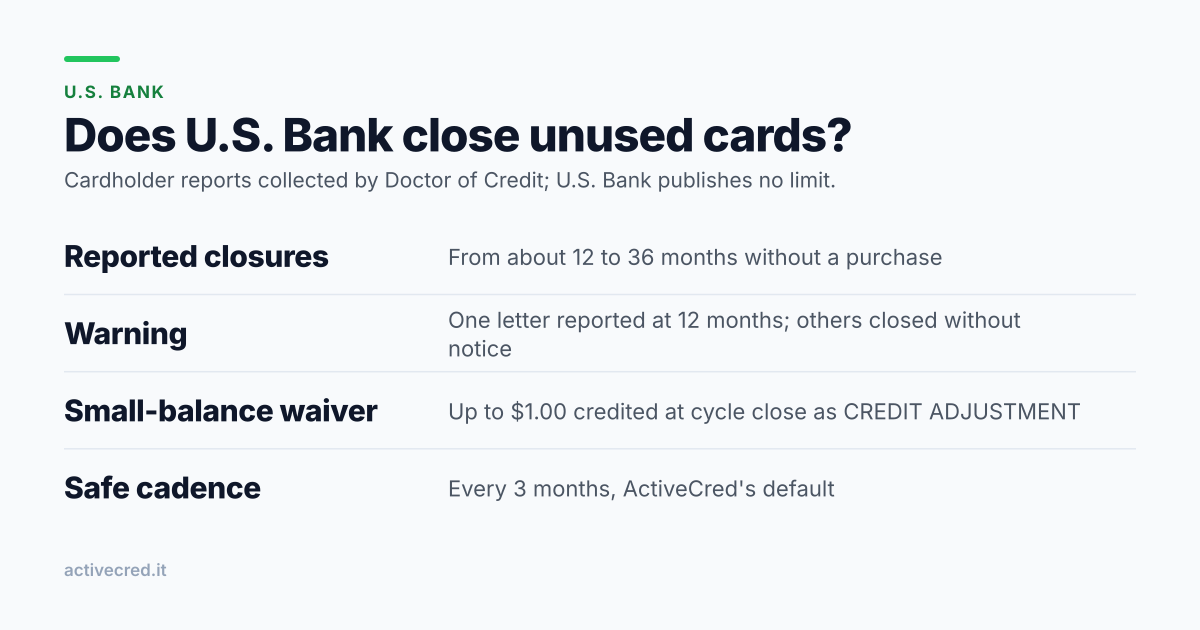
U.S. Bank is reported closing unused cards anywhere from 12 months to about three years after the last purchase, sometimes with a warning letter and sometimes without. Both U.S. Bank and its sister issuer Elan Financial credit statement balances up to $1.00 at cycle close. ActiveCred charges each linked card every 3 months by default, or every 6 months if the cardholder prefers.
Try the demo or check a U.S. Bank cardU.S. Bank's consumer cards are popular among category-rewards optimizers: Cash+ pays 5% on two chosen categories, Altitude Go pays 4x on dining, and Altitude Connect dropped its $95 annual fee in 2024 to become a no-fee travel card. Because U.S. Bank's underwriting is stricter than average (famously sensitive to recent accounts and inquiries), getting approved takes patience, and losing an older U.S. Bank line to inactivity is harder to undo with a quick replacement application.
What the record shows
U.S. Bank publishes no inactivity deadline in its cardmember agreement. The public evidence comes from reader reports compiled by Doctor of Credit and stored in ActiveCred's public issuer data file (checked November 22, 2026).
Those reports span a wide band: one cardholder received an inactivity warning letter at 12 months without a purchase, while another had an account closed after roughly three years with no warning at all. Because federal Regulation B does not require advance notice for inactivity closures, treating 12 months as the working floor is the cautious reading. The issuer-by-issuer timeline sets U.S. Bank alongside the other twelve banks tracked.
Which U.S. Bank cards sit exposed, and how Elan Financial differs
Three parts of the U.S. Bank family behave differently when left in a drawer:
- No-fee consumer cards (Cash+, Altitude Go, Altitude Connect, Shield / Platinum, Smartly). Altitude Connect is a newly exposed case: cardholders who opened it as a $95 annual-fee card and stopped using it after the fee went to $0 no longer have an annual fee shielding the account from inactivity reviews. Note also that Cash+ requires quarterly category activation for 5% rewards, though any posted purchase (even at 1%) resets the inactivity clock.
- Annual-fee cards (Altitude Reserve, Shopper Cash Rewards after year one, co-branded Korean Air, Kroger or REI legacy transitions). Cards billing an annual fee are seldom closed for inactivity while the fee is paid, though downgrading Shopper Cash Rewards or Altitude Reserve to a no-fee card immediately moves the account into the standard review pool.
- Elan Financial Services (credit union and community bank cards). Elan is a U.S. Bank subsidiary that issues Max Cash Preferred and everyday Visa and Mastercard lines for hundreds of credit unions, Fidelity Rewards Visa, and regional banks. On Doctor of Credit's record, Elan is noticeably slower to act than U.S. Bank proper, with one reported closure at 48 months without warning.
The $1.00 CREDIT ADJUSTMENT on statements
Both U.S. Bank and Elan Financial are reported to zero out statement balances of $1.00 or less at cycle close with a line labeled CREDIT ADJUSTMENT. One exception appears in the reports: if an annual fee posts during that same billing cycle, U.S. Bank bills the entire balance together without waiving the small purchase.
When a $0.50 activity charge runs on an otherwise empty Cash+ or Altitude Go statement, the purchase settles through Visa first (resetting the bank's last-purchase timestamp) and the CREDIT ADJUSTMENT arrives days later on statement day. Leave full-statement autopay turned on in case U.S. Bank changes its threshold, or set the charge to $2.00 if an ordinary statement draft is desired. Small-balance credit card waivers, by bank walks through the full ledger sequence.
Points, reopening and FICO impact
Cash back on Cash+ and points on Altitude Go or Altitude Connect do not expire while the account remains open and in good standing under U.S. Bank's current terms, whereas closing an account can forfeit unredeemed balances below redemption minimums or outside short grace windows; redeeming rewards before shelving a card avoids that risk.
U.S. Bank publishes no formal reopening policy after an inactivity closure, and because its new-account underwriting weighs recent inquiries heavily (often cited by cardholders as sensitive to more than one or two new accounts in the past twelve months), asking whether a closed card can be restored without a new application matters even more here than at looser issuers. If the card stays closed, its limit drops out of available credit at once, raising utilization in amounts owed (30% of a FICO score), and its age leaves length of credit history (15%) when the closed tradeline drops off the report up to ten years later.
The safe cadence
Against U.S. Bank's earliest 12-month report, one purchase every six months sits at half the window, and ActiveCred's default three-month schedule leaves nine months of margin while covering stricter banks like Wells Fargo on the same timetable.
| Schedule | Against U.S. Bank's 12 months | Against Elan's 48 months |
|---|---|---|
| Every three months (ActiveCred default) | 9 months to spare | 45 months to spare |
| Every six months (optional per-card setting) | 6 months to spare | 42 months to spare |
To check a specific card's date, open the inactivity checker, set to U.S. Bank (or select Elan Financial on the same page for a credit union card).
In short
U.S. Bank closures start at 12 months on the public record, warning letters are inconsistent, and replacing a lost U.S. Bank tradeline means clearing strict underwriting a second time. One small purchase every three to six months keeps activity posting, and up to $1.00 U.S. Bank typically waives the statement balance as a CREDIT ADJUSTMENT.