A cardholder puts a $0.50 charge on an unused Wells Fargo or U.S. Bank card, waits for the statement to close, and finds a surprise. Alongside the purchase sits a second line for +$0.50 labeled "ACCOUNT ADJUSTMENT" or "CREDIT ADJUSTMENT", and the statement balance is $0.00. It looks as if the bank rejected the transaction. In fact the purchase cleared, posted and counted; the bank only forgave the pocket change on statement day because collecting fifty cents costs more than writing it off.
A small-balance waiver does not undo a posted purchase. Several US banks write off statement balances of $1.00 or $2.00 at cycle close rather than pay to bill and collect them. The merchant charge has already posted to the ledger and reset the inactivity clock. ActiveCred puts a scheduled charge on each linked card, starting at $0.50.
Try the demo or jump to pricingWhat happened on the statement
Two separate events appear in the transaction list, separated by days. First, a merchant purchase clears the card network and posts as a finalized debit, complete with a merchant name, category code and settlement date. Second, on the day the billing cycle closes, the bank's statement job checks the ending balance, sees fifty cents, and posts an internal credit for the same amount so the statement closes at $0.00.
Had the bank blocked or reversed the sale, there would be no posted purchase on the statement, or there would be a merchant reversal attached to the authorization. Instead both lines stand in the ledger. The first line is the customer's purchase; the second is the bank settling the bill on the customer's behalf.
Why banks forgive small balances
Billing a tiny balance is a losing trade for an issuer. Printing and mailing a paper statement, running an ACH draft through autopay, answering a phone call about fifty cents, or carrying pennies across delinquency buckets costs the bank more in postage, servicing and network fees than the balance is worth.
So several issuers run an automated rule at statement cut: if the remaining balance is above zero and at or below a dollar or two, zero it out with a courtesy credit. No US bank advertises the rule in its marketing, and no cardholder agreement promises it as a benefit. It exists for the bank's own accounting.
Why the purchase still counts as activity
An issuer's inactivity review looks for one thing: the date of the most recent outbound posted transaction. When a $0.50 purchase settles through Visa, Mastercard, American Express or Discover, it writes a posted purchase date to the account and earns the issuer interchange. That is the record the review reads.
The waiver arrives later, from the billing ledger, and works the same way a payment or a merchant refund does. Neither erases the earlier purchase date. By contrast, a small-balance adjustment on its own is not activity, and could never arise without a charge or residual cent to trigger it; it is the purchase underneath that resets the clock.
Which banks waive small balances
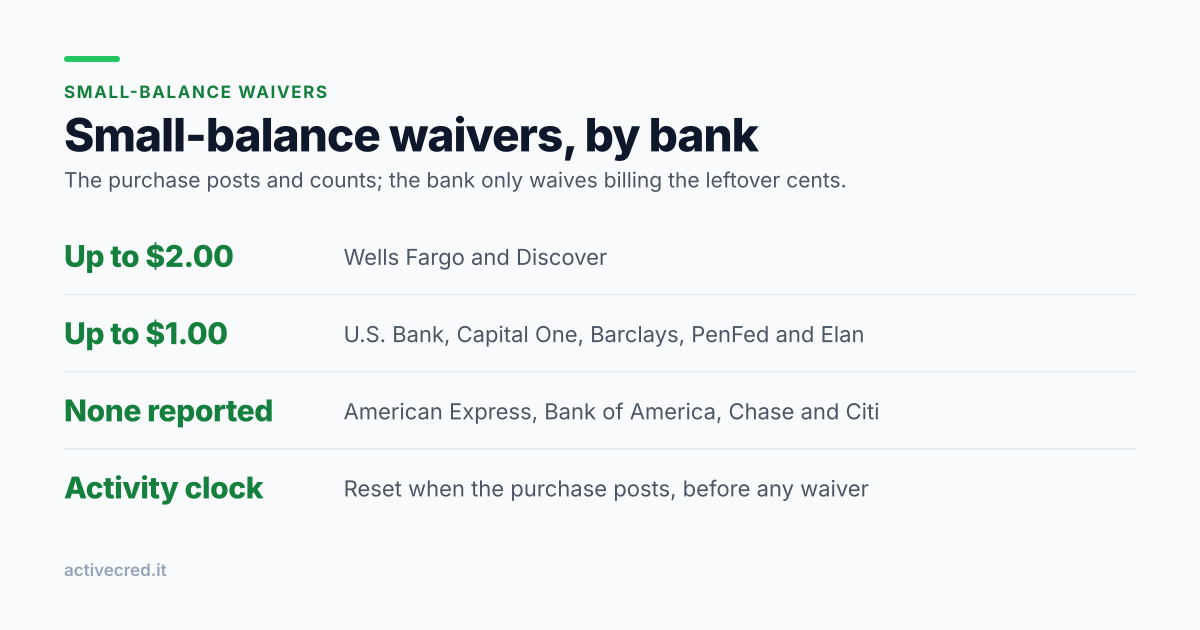
No bank publishes its threshold, and any bank can change its software without notice. The figures below come from cardholder statements collected by Doctor of Credit and kept alongside the closure windows in ActiveCred's issuer data file, checked on November 22, 2026.
| Issuer | Reported waiver | Typical statement line |
|---|---|---|
| Wells Fargo | Up to $2.00 | ACCOUNT ADJUSTMENT |
| Discover | Up to $2.00 (some $1.00 post-merger) | SMALL BALANCE CREDIT |
| U.S. Bank | Up to $1.00 | CREDIT ADJUSTMENT |
| Capital One | Up to $1.00 | SMALL BALANCE ADJUSTMENT |
| Barclays | Up to $1.00 | SMALL BALANCE WAIVER |
| PenFed | Up to $1.00 | CREDIT ADJUSTMENT |
| Elan Financial | Up to $1.00 | CREDIT ADJUSTMENT |
| Amex, Bank of America, Chase, Citi | None reported | Billed as normal |
| Synchrony, Comenity | None reported | Billed as normal |
Two details in the reports are worth knowing. First, U.S. Bank skips the waiver in a billing cycle where an annual fee posts, so the whole balance bills together. Second, Capital One completed its acquisition of Discover in 2025, and migrated Discover accounts have begun reporting Capital One's $1.00 ceiling rather than Discover's older $2.00 one.
Why autopay still belongs on the card
Because a small-balance waiver is an unwritten courtesy rather than a term of the account, a cardholder should never turn off autopay and assume the bank will keep forgiving the bill. Chase and Comenity both waived small balances years ago and stopped without an announcement. A card whose waiver ends while nobody is watching turns a $0.50 charge into a $30 late fee and, 30 days on, a late mark in payment history, 35% of a FICO score.
There is a second reason not to treat the waiver as a monthly game. Credit forums have long traded stories of loading $0.99 or $1.99 onto twelve cards every month solely to pocket the write-off. Used once a quarter on an idle card, a $0.50 purchase is ordinary maintenance; engineered every month across a stack of accounts to harvest credits, it looks like abuse to a bank that can close any card at will.
When to leave the charge at $0.50, and when to raise it
For most cardholders running the mini-charge strategy once a quarter, nothing needs to change when an adjustment appears. Keep full-statement autopay turned on: in cycles where the bank waives the $0.50 balance, the statement closes at $0.00 and autopay rests; in any cycle where the bank bills it, autopay pays it on the due date.
Some cardholders prefer to see a billed statement and an autopay draft every time, either to confirm their checking link works or to avoid recurring write-offs altogether. Moving the charge above the bank's reported ceiling does that: $2.00 clears a $1.00 threshold at U.S. Bank, Capital One, Barclays, PenFed or Elan, and $3.00 clears a $2.00 threshold at Wells Fargo or Discover.
In short
An "ACCOUNT ADJUSTMENT" at Wells Fargo or a "CREDIT ADJUSTMENT" at U.S. Bank is the bank forgiving a statement bill that would cost more to collect than it is worth. The purchase posted days earlier, and the inactivity clock moved with it.
Leave autopay on, let the quarterly purchase post, or step the charge above $1.00 or $2.00 if a normal bill is wanted.