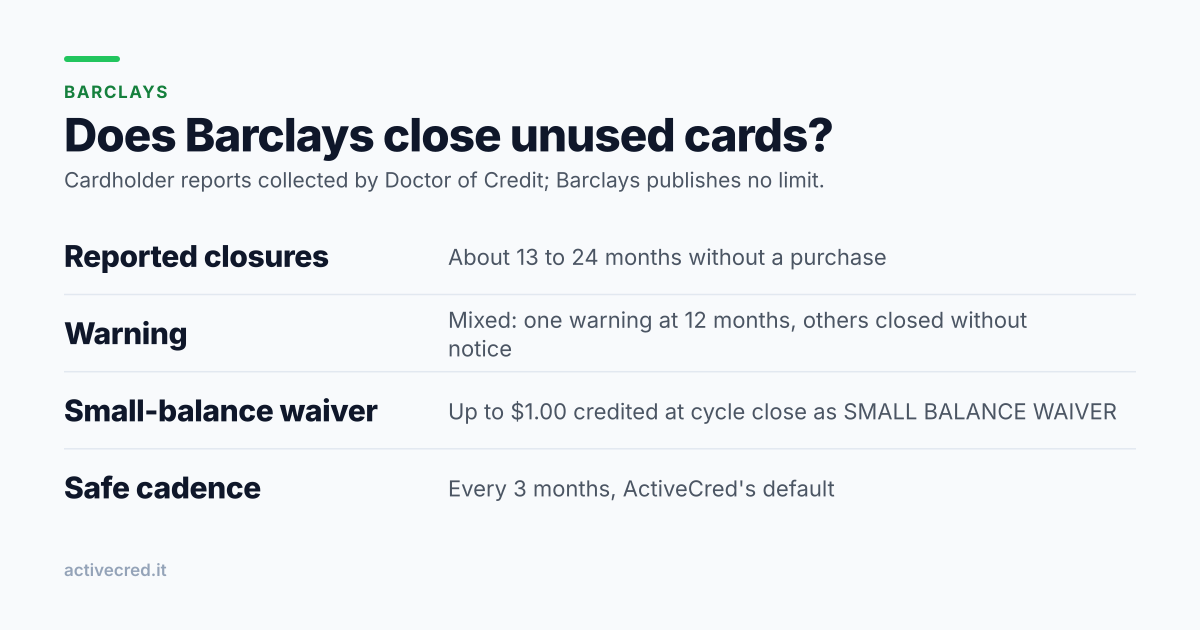
Barclays US Consumer Bank is reported closing unused cards between 13 and 24 months after the last purchase. Some cardholders receive a warning at 12 months; others learn only after the account closes. Barclays also waives statement balances up to $1.00 at cycle close. ActiveCred charges each linked card every 3 months by default, or every 6 months if the cardholder prefers.
Try the demo or check a Barclays cardBarclays occupies an unusual corner of the US credit card market. Rather than promoting a flagship branch card of its own, Barclays US Consumer Bank issues co-branded Mastercards for airlines, hotels, cruise lines and retailers: JetBlue, Wyndham, Hawaiian Airlines, Frontier, Breeze, Emirates, Barnes & Noble, GAP Inc. (transferred portfolios) and legacy AAdvantage Aviator accounts, plus discontinued bank cards such as the Uber Visa, Sallie Mae Mastercard and Arrival.
Travelers open those partner cards for a sign-up bonus or a free checked bag, downgrade to a no-fee tier a year later, and tuck the card in a drawer until the next trip on that carrier. That gap between trips is where Barclays' inactivity reviews catch them.
What the record shows
Barclays publishes no fixed inactivity period in its US cardholder agreements. In the closures gathered by Doctor of Credit and maintained in ActiveCred's public issuer data file (checked November 22, 2026), cardholders report closures between 13 and 24 months without a posted purchase.
Most accounts sit in the 18-to-24-month range, while the earliest report describes a warning letter arriving at 12 months of silence followed by closure at 13 months when no purchase posted. Other cardholders received no advance letter at all, which federal Regulation B allows for inactivity actions. The notice record across issuers compares which banks write ahead and which write afterward.
Which Barclays cards are most exposed
Cards carrying an annual fee (such as JetBlue Plus at $99, Wyndham Earner Business or AAdvantage Aviator Red) are seldom closed for inactivity while the fee is paid each year. The exposure concentrates in two groups:
- Downgraded no-fee partner cards. Travelers who product-change an annual-fee card to the no-fee JetBlue Card, Wyndham Earner Card or legacy no-fee Aviator card keep their credit line and opening date, then stop spending on the card because its everyday earn rate is modest.
- Legacy discontinued cards. Older Barclays View (converted from the Uber Visa), Arrival (no-fee version) and Ring accounts cannot be opened again once closed, and often anchor the oldest years of a cardholder's file.
What happens to airline miles and hotel points
On a co-branded airline or hotel card, rewards earned on earlier statements have already swept over to the partner loyalty program: TrueBlue, Wyndham Rewards, HawaiianMiles or AAdvantage. Closing the Barclays credit card does not erase miles already sitting inside the airline or hotel account, though closing the card can restart a partner program's own points-expiration clock (for example, Wyndham points expire after 18 months without program activity). By contrast, points kept inside Barclays' own portal on legacy Arrival or View cards should be redeemed before an account goes idle; the rewards guide covers both models.
The $1.00 SMALL BALANCE WAIVER at Barclays
Barclays US is one of seven issuers reported to forgive tiny statement balances at cycle close. When a billing period ends with $1.00 or less owed and no other charges, cardholders report seeing a credit labeled SMALL BALANCE WAIVER that brings the statement balance to $0.00.
Because the underlying $0.50 or $1.00 purchase cleared Mastercard days before statement cut, the card's activity date has already updated; the waiver simply spares Barclays the cost of billing fifty cents. Keep full-statement autopay switched on in case Barclays changes its threshold without notice, or step the charge to $2.00 if an ordinary statement draft is preferred. Small-balance waivers, by bank covers all seven issuers.
Reopening and FICO impact
Barclays publishes no guarantee on reopening a card closed for inactivity, and forum reports are mixed: reconsideration analysts sometimes restore a recently closed line after a credit pull, and sometimes require a fresh application (which fails completely on discontinued cards such as Barclays View). If the card stays closed, its credit limit leaves total available credit right away, raising utilization inside amounts owed (30% of a FICO score), while a closed account in good standing stays in length of credit history (15%) until it drops off the report up to ten years later.
The safe cadence
Against Barclays' shortest 13-month report, one posted purchase every six months leaves seven months to spare, and ActiveCred's default three-month schedule leaves ten months to spare while matching every stricter bank in the wallet.
| Schedule | Against Barclays' 13 months | Against the shortest window, 10 months at Wells Fargo |
|---|---|---|
| Every three months (ActiveCred default) | 10 months to spare | 7 months to spare |
| Every six months (optional per-card setting) | 7 months to spare | 4 months to spare |
For a Barclays card whose last purchase date is known, the inactivity checker, set to Barclays shows where the account sits inside the 13-to-24-month reported window.
In short
Downgraded airline and hotel Mastercards from Barclays are prime candidates to be forgotten between trips, and closures start at 13 months on the public record, with inconsistent warnings. One small purchase every three to six months resets the clock, and at $0.50 or $1.00 Barclays often credits the statement balance at cycle close.