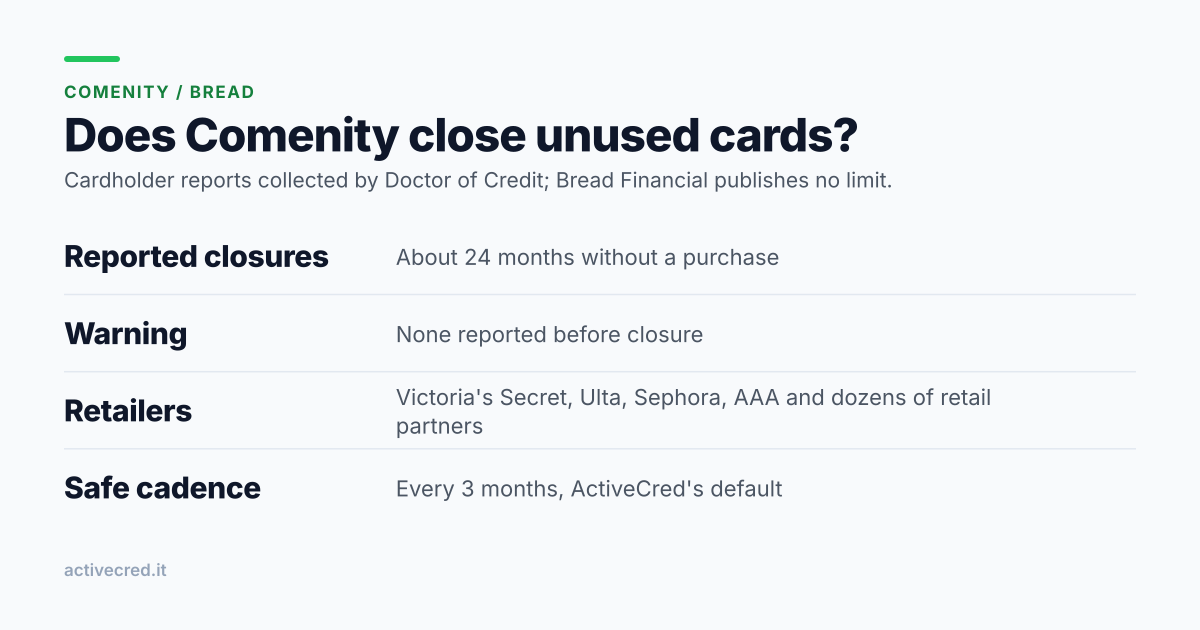
Comenity Bank and Comenity Capital Bank (now Bread Financial) are reported closing unused retail and co-branded cards at about 24 months without a purchase, without advance warning. Co-branded Comenity cards with a Visa, Mastercard or Amex logo work with ActiveCred's default 3-month schedule; closed-loop store cards need a purchase at the retailer by hand.
Try the demo or check a Comenity cardWhen someone searches "Victoria's Secret closed my credit card" or wonders why an old Ulta, Sephora or Express account suddenly reads "COMENITYBANK / closed by credit grantor" on a bureau report, the bank behind the decision is Bread Financial. Through its two banking charters, Comenity Bank and Comenity Capital Bank, Bread Financial runs more than a hundred mall, beauty, apparel, home and auto-club card programs across the United States.
What the record shows
Neither Comenity charter publishes a fixed inactivity deadline in its cardmember agreements. In the closures reported by cardholders to Doctor of Credit and tracked in ActiveCred's public issuer data file (checked November 22, 2026), Comenity accounts are reported closing at about 24 months without a posted purchase, with no warning letter ahead of time.
A second trigger catches Comenity cardholders even earlier: network conversions and retailer exits. When Victoria's Secret upgraded millions of store-only cards to co-branded Mastercards, and when other specialty chains changed banks or wound down stores, long-idle accounts were routinely closed rather than reissued on the new rail. Keeping a recent purchase on file keeps an account in the active cohort whenever a retailer refreshes its plastic.
Why "Victoria's Secret closed my credit card" is so common
Retail checkout cards from Victoria's Secret, Pink, Ulta Beauty, Sephora, Lane Bryant, Express, Ann Taylor, Loft, Ikea Projekt, B&H Payboo, Caesars Rewards and AAA are frequently opened in a cardholder's teens or early twenties for a first-purchase discount. Five or ten years later, shopping habits change, the balance sits at $0, and the account becomes the oldest tradeline on the credit file.
Two things happen when Comenity closes that card for inactivity:
- Utilization rises on the next statement cycle. Even a $1,000 or $2,500 store limit counts in total available credit, part of amounts owed (30% of a FICO score). Losing two or three forgotten Comenity mall cards in the same year can trim several thousand dollars of headroom at once.
- The oldest account drops off up to ten years later. Under FICO's rules, a card closed in good standing stays on the credit report and keeps contributing to length of credit history (15% of a FICO score) for up to ten years, then leaves the file altogether. How long closed accounts stay on a credit report walks through that second step.
Closed-loop vs co-branded Comenity cards
Many Comenity retail partners issue two versions of the same brand card: a closed-loop store card for in-store and website checkout only, and a co-branded Mastercard, Visa or American Express version that works everywhere. Store credit cards and inactivity closures explains why the rail determines how to keep the card active:
| Comenity / Bread card | Network rail | How to put activity on it |
|---|---|---|
| Bread Cashback Amex, AAA Daily Advantage & Travel Advantage Visa | Open-loop Visa or Amex | Any merchant, or automated via ActiveCred |
| Victoria's Secret Mastercard, Ulta Beauty Mastercard, Sephora Visa, Caesars Visa, PlayStation Visa | Co-branded Visa or Mastercard | Any merchant, or automated via ActiveCred |
| Store-only Victoria's Secret, Ulta, Sephora, Lane Bryant, Express, Ikea Projekt, B&H Payboo | Closed-loop private label | Manual purchase at that retailer only |
Autopay and Comenity's retired small-balance waiver
Years ago, forum lists included Comenity among banks that wrote off $1.00 statement balances. Comenity ended that practice without an announcement, and Bread Financial upgraded its Account Center billing platform in 2022. Today a $0.50 or $1.00 charge on a Comenity card bills in full, and Comenity's late fees are steep. Always verify that full-statement autopay is active inside Comenity's Account Center before setting up any recurring charge; the small-balance waiver guide notes why Chase and Comenity serve as cautionary examples.
Can a closed Comenity card be reopened?
Comenity rarely reopens accounts closed for inactivity without treating the request as a fresh application, and the "closed by credit grantor" remark stays on the tradeline while it ages off over ten years. Calling customer care promptly is still free to try, though keeping one small purchase posting before the two-year mark is far more reliable than asking afterward.
The safe cadence
Against Comenity's reported 24-month closure mark, one purchase a year sits at half the window, and ActiveCred's default three-month schedule leaves 21 months of margin while protecting faster-closing store banks such as Synchrony (12 months) on the same calendar.
For a Comenity or Bread Financial card whose last purchase date is known, the inactivity checker, set to Comenity calculates how much of the reported 24-month window remains and the date to use the card by.
In short
Comenity and Bread Financial sit behind Victoria's Secret, Ulta, Sephora, AAA and scores of mall cards that often form the oldest lines on a credit report. Closures arrive at about 24 months without warning, and no small-balance waiver softens a forgotten bill. Pair full-statement autopay with a quarterly purchase: automated if the card carries a Visa, Mastercard or Amex logo, or at the store if it does not.