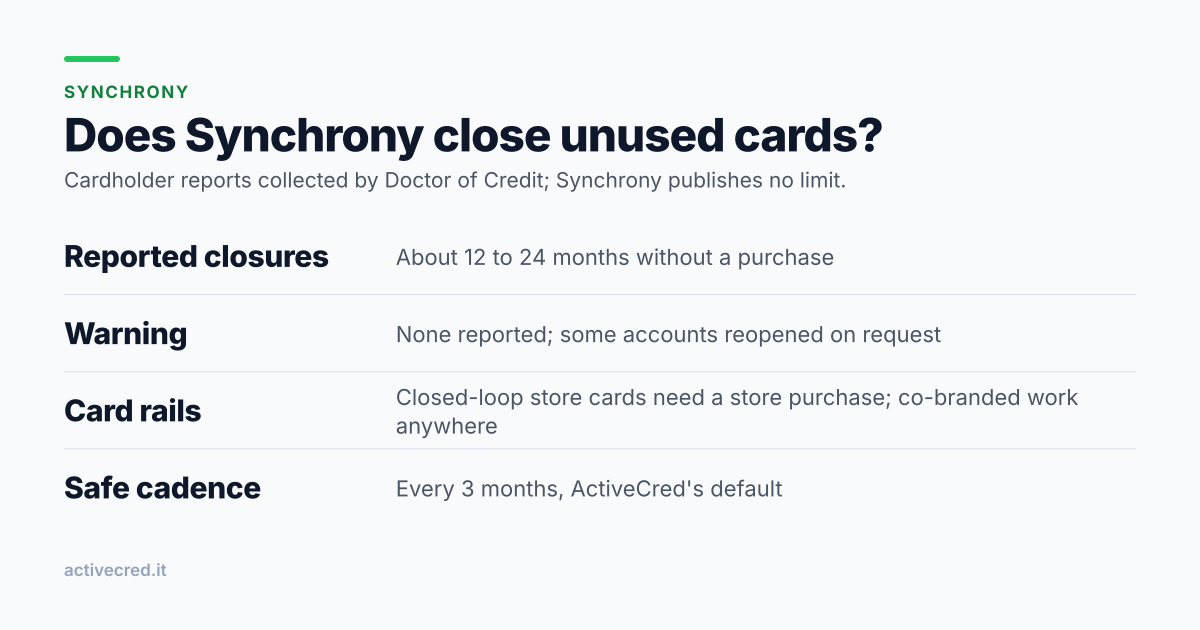
Synchrony Bank is reported closing unused store and co-branded cards at about 12 to 24 months without a purchase, usually without advance notice. Some cardholders report reopening an account on request. Co-branded Synchrony Visas and Mastercards work with ActiveCred's default 3-month schedule; closed-loop store cards must be used at the retailer by hand.
Try the demo or check a Synchrony cardMany cardholders do not realize they hold a Synchrony Bank account until a credit bureau alert announces that "SYNCB" has cut a limit or closed a line. Synchrony is the largest issuer of retail credit in the United States, standing behind store cards and financing lines for Amazon, Lowe's, Sam's Club, CareCredit, JCPenney, TJX and dozens of specialty merchants, alongside open-loop cards for PayPal, Venmo and Verizon.
What the record shows
Synchrony publishes no inactivity window in its cardholder agreements. In the closures reported by readers to Doctor of Credit and tracked in ActiveCred's issuer data file (checked November 22, 2026), Synchrony closes unused accounts between 12 and 24 months after the last posted purchase, with Amazon Store Card accounts often reported toward the two-year mark and Sam's Club and specialty financing lines as early as 12 months.
Two patterns stand out across Synchrony forums. First, advance warning before closure is not reported. Second, Synchrony is unusually active with credit-limit reductions on idle or lightly used lines: an account opened for a $4,000 furniture, dental or home-improvement promotional payoff is frequently trimmed to $500 or $1,000 once the promotional balance reaches $0, and closed a cycle or two later if no new purchase posts. Paying off a promotional plan does not reset the activity clock; only a new posted purchase does.
Which cards are Synchrony cards, and which rail they use
How an idle Synchrony card stays active depends entirely on whether it carries a Visa or Mastercard logo. Store credit cards and inactivity closures draws the line between the two rails:
| Synchrony card | Network rail | How to put activity on it |
|---|---|---|
| PayPal Cashback Mastercard, Venmo Visa, Verizon Visa | Open-loop Visa or Mastercard | Any merchant, or automated via ActiveCred |
| Sam's Club Mastercard, TJX Rewards Platinum Mastercard, CareCredit Mastercard | Co-branded Mastercard | Any merchant, or automated via ActiveCred |
| Amazon Store Card, Lowe's Advantage, JCPenney, Discount Tire, standard CareCredit | Closed-loop private label | Manual purchase at that merchant or provider only |
A closed-loop card has no 16-digit Visa, Mastercard, Amex or Discover routing number, so no outside subscription or service can charge it. For an Amazon Store Card, reloading a small Amazon gift balance or putting one household item on Subscribe & Save every few months keeps purchases posting. For CareCredit's closed-loop version, many pharmacies and Rite Aid or Walgreens optical and health counters accept the card for everyday drugstore items, sparing the cardholder a trip to the dentist just to reset the clock.
No small-balance waiver reported
Unlike Wells Fargo or U.S. Bank, Synchrony has no reported small-balance statement waiver. A $0.50 or $1.00 purchase on a PayPal Mastercard or Venmo Visa bills in full on the statement date, so full-statement autopay from a checking account is essential whenever a recurring micro-charge is set up. Missing a $0.50 bill for 30 days damages payment history, 35% of a FICO score, just as surely as missing a $500 bill.
Reopening a closed Synchrony account
Synchrony is one of the brighter spots in the reopening record. On Doctor of Credit's list, several cardholders report calling Synchrony after an inactivity closure and having the existing tradeline reopened on request, keeping its original opening date. That outcome is never guaranteed, becomes less likely once weeks pass, and may involve a credit review, so calling the day the closure appears and asking whether a hard inquiry is required before consenting is the right order of steps.
If Synchrony declines to reopen the line, the closed limit leaves total available credit at the next bureau update, lifting utilization inside amounts owed (30% of a FICO score). Because CareCredit and Lowe's lines often carry $5,000 to $15,000 limits built for project financing, losing one can move overall utilization noticeably. A closed account in good standing continues to count toward length of credit history (15%) until it drops off the report up to ten years later.
The safe cadence
With reported closures starting at 12 months, charging every six months sits at half the shortest report, and charging every three months leaves nine months to spare while matching the schedule needed at stricter banks such as Wells Fargo.
For a Synchrony card whose last purchase date is known, the inactivity checker, set to Synchrony shows where the card stands against the 12-to-24-month reported window and the date to use it by.
In short
Synchrony closes unused retail and co-branded cards in as little as 12 months without warning, and trims idle limits even sooner. Check whether the card carries a Mastercard or Visa mark: if it does, automation can put a small charge on it every quarter; if it is closed-loop, a quarterly purchase at the partner store does the same job by hand.