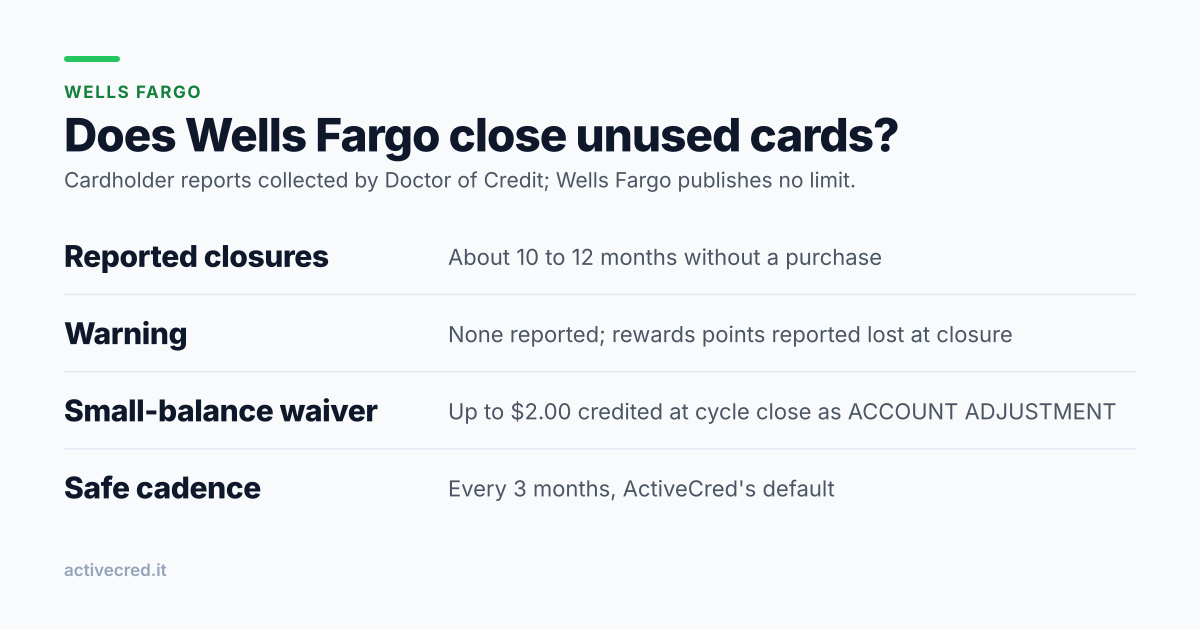
Wells Fargo has the shortest reported inactivity window of any large US card issuer, at about 10 to 12 months without a posted purchase. Advance notice is not reported, and unredeemed rewards points are reported lost when the account closes. Once a year is too slow for a Wells Fargo card; ActiveCred charges each linked card every 3 months by default.
Try the demo or check a Wells Fargo cardThe advice to put one purchase a year on an unused credit card breaks first at Wells Fargo. Across the cardholder reports collected over the past several years, Wells Fargo is the only major bank reported closing unused consumer cards inside a single year. Because its lineup leans heavily on no-fee cards, millions of Active Cash, Autograph and Reflect accounts sit exposed once everyday spending moves elsewhere.
What the record shows
Wells Fargo publishes no inactivity timetable in its consumer card agreements; like every other US issuer, it reserves the right to close or lower the limit on an account at any time. The public record comes from reader accounts collected by Doctor of Credit and tracked in ActiveCred's public issuer data file, checked on November 22, 2026.
Those reports put Wells Fargo closures at about 10 to 12 months since the last posted purchase. By comparison, American Express and Chase start at about 12 months, Discover at about 18 months, and Bank of America, Capital One and Citi at two years or more. The full issuer-by-issuer table compares all thirteen issuers on record.
Why Wells Fargo acts sooner is not stated, though its product mix offers a clue. Active Cash (2% cash rewards), Autograph (points on travel and dining) and Reflect (a long introductory 0% APR card) carry no annual fee. A Reflect card opened for a balance transfer and paid off eighteen months later often goes straight into a drawer, earning the bank neither interest nor interchange while its credit line stays open on the bank's books.
No warning, and points lost on closure
Two details make a Wells Fargo inactivity closure sharper than one at Chase or Bank of America. First, cardholders do not report receiving a 30-day warning letter or email ahead of closure. Under federal Regulation B, closing an account because of inactivity is exempt from adverse-action notice rules, so the first sign is often an alert from a credit bureau or a card that disappears from the Wells Fargo app. Which banks warn before closing sets out the difference across issuers.
Second, Wells Fargo Rewards points and unredeemed cash rewards sitting on a closed account are reported forfeited when the bank shuts the card down, unless another open Wells Fargo Rewards account holds the same pool. The rewards closure guide covers how to cash out or transfer balances before a card goes quiet.
Which Wells Fargo cards face inactivity reviews
Almost every consumer card Wells Fargo sells has no annual fee, which puts almost the whole catalog in the review pool once purchases stop:
- Active Cash and legacy Cash Wise / Platinum cards. Old Platinum cards are often a cardholder's earliest tradeline at the bank; losing one removes its credit limit from utilization at once and, when the closed account leaves the credit report up to ten years later, takes its age with it.
- Autograph and Propel World / Amex legacy accounts. Discontinued no-fee cards such as Propel cannot be applied for again if closed.
- Reflect. Built for balance-transfer payoffs, Reflect offers no rewards after the promotional window ends, making it the classic card a cardholder pays to $0 and forgets. Paying down a balance is not a purchase; a paid-off card at $0 still counts as idle.
- Bilt legacy transfers (Autograph conversions) and Choice Privileges Select / Autograph Journey. Fee-paying cards ($95 on Autograph Journey) are rarely closed for inactivity on Doctor of Credit's record, whereas converted no-fee accounts lose that buffer.
The $2.00 ACCOUNT ADJUSTMENT on Wells Fargo statements
Cardholders who put a $0.50 or $1.00 charge on an idle Wells Fargo card often notice something odd when the billing cycle closes: a credit for the exact same amount labeled ACCOUNT ADJUSTMENT, leaving a $0.00 statement balance and nothing for autopay to draft.
That credit is a small-balance waiver, not a reversal. Wells Fargo is reported to write off statement balances up to $2.00 at cycle close rather than pay to bill and collect pocket change. Crucially, the merchant purchase cleared Visa or Mastercard days earlier and wrote a posted purchase date to the account, which is what counts as activity. Small-balance credit card waivers, by bank explains how the ledger records both lines, why full-statement autopay should stay turned on anyway, and why stepping a charge to $3.00 produces a normal payable bill if the cardholder prefers one.
Can a closed Wells Fargo card be reopened?
Wells Fargo publishes no formal reactivation window after an inactivity closure, and cardholder reports of successful reopenings are scarce; most callers are told to submit a new application, which brings a hard inquiry and a new account opening date rather than restoring the old tradeline. Calling the number on the back of the card the day a closure is spotted costs nothing, and the reopening guide lists the exact questions to ask before agreeing to a credit pull.
When a closure stands, its effect on a FICO score arrives in two stages: amounts owed (30% of a FICO score) feels the lost credit limit as soon as the next statement reports, while length of credit history (15%) keeps counting a closed account in good standing until it drops off the report up to ten years later.
The safe cadence for Wells Fargo
Because Wells Fargo sets the 10-month floor across major US banks, an annual reminder is two months too late. Charging at half the shortest reported window gives five months; charging once a quarter gives seven months of margin and puts every bank card in a wallet on one calendar.
| Schedule | Against Wells Fargo's 10 months | Practical fit |
|---|---|---|
| Every three months (ActiveCred default) | 7 months to spare | Clears every bank on record |
| Every five months (half-window) | 5 months to spare | Longest safe gap for Wells Fargo |
| Once a year | 2 months too late | Unsafe at Wells Fargo |
If the date of the last purchase on a Wells Fargo card is known, the inactivity checker, set to Wells Fargo calculates how much of the 10-to-12-month window has elapsed and the date to use the card by.
In short
Wells Fargo leaves less room for neglect than any other big US card issuer: closures are reported at 10 to 12 months without a purchase, without advance warning and with unredeemed points lost. One small posted purchase every three months stays well inside that mark, even when Wells Fargo waives the leftover cents as an ACCOUNT ADJUSTMENT at statement close.