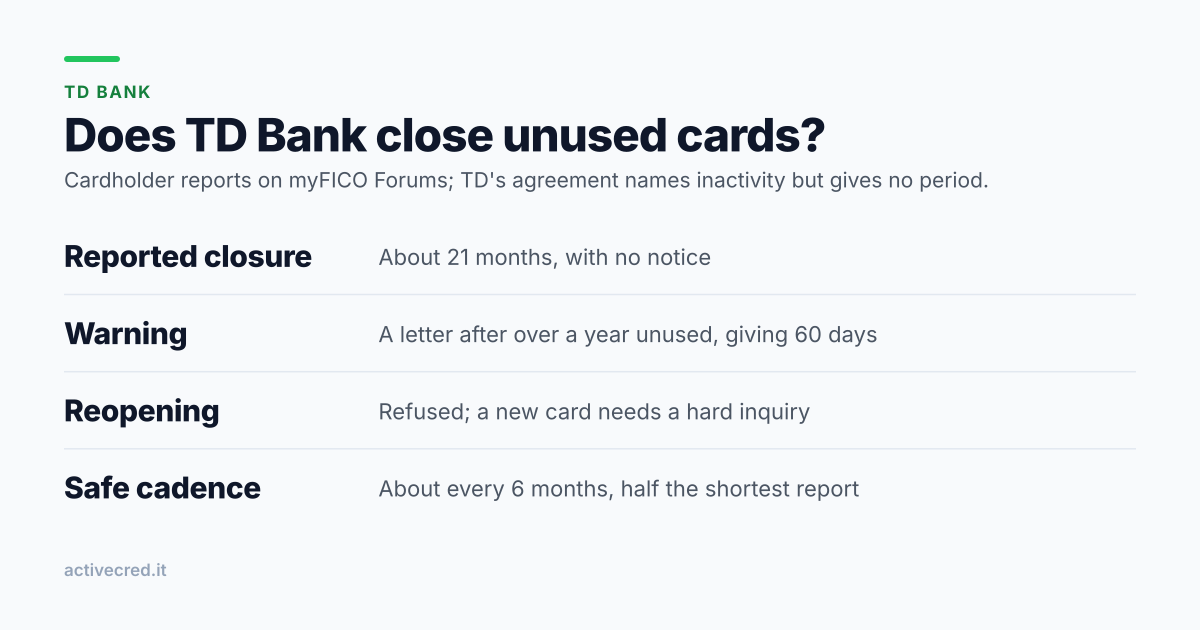
TD Bank closes credit cards that go unused, and its own card agreement says so. The TD Cash agreement lets the bank close an account for any reason, inactivity included, and without prior notice. One TD Cash card was closed after about 21 months without a purchase and no warning; another cardholder got a letter after over a year unused, giving 60 days to use the card. The Target and Nordstrom store cards that TD also issues have a different record, and the shortest report there is about 6 months.
TD Bank's agreement names inactivity as a reason to close, and one TD Cash card went at about 21 months with no notice. Another cardholder got 60 days' warning by letter after over a year unused. The one closed card could not be reopened. ActiveCred charges each linked card every 3 months by default, or on any schedule the cardholder chooses.
Check your TD Bank card or try the demoWhat TD's agreement says
Section 7A of the TD Cash agreement, as published by TD Bank with rates dated October 29, 2026, says TD may close the account "for any reason including Account inactivity" and "without prior notice". The TD Double Up agreement has the same clause. Neither gives a number of months.
The agreements of FNBO, USAA and PenFed reserve a general right to close and do not mention inactivity at all. TD writes it down, which settles whether it happens. How soon is left to the cardholder reports below.
What TD cardholders report
The clearest case, posted on myFICO Forums in April 2021, is a TD Cash card with a $10,000 limit. It was last used in June 2019 and closed in early April 2021, about 21 months later. No letter came first. A TD representative told the cardholder that the bank sometimes gives notice but is not required to. The cardholder also had a TD checking account and a TD mortgage, and neither stopped the closure.
A January 2024 thread on myFICO Forums shows the other path: a mailed letter, sent after the card had gone unused for over a year, saying the account would close unless the card was used within 60 days. The cardholder used it the next day, so the thread does not show when TD would have acted. A March 2024 post on myFICO Forums lists a TD Cash Rewards Visa as closed due to inactivity, without saying how long it had sat unused.
These are cardholder reports, not TD policy, and three posts on one forum are a thin record. A member in the 2021 thread said TD usually acts once a card has sat unused for 12 months; that is one person's view, not a reported case. A bank can also change its practice without announcing it.
Target and Nordstrom cards have their own record
TD Bank USA also issues store cards, including the Target card and the Nordstrom card. Reports about them do not match the TD-branded cards, and ActiveCred's issuer data keeps them apart:
- About 6 months unused: a Target store card closed, reported in a 2022 thread on myFICO Forums.
- About 40 months unused: a Nordstrom card by TD still open, in the same thread.
- Nearly 18 months unused: a Target cardholder got a letter asking for use by a set date, in a 2016 thread on myFICO Forums.
- Thirteen months unused: a Target card's limit cut to $200 rather than closed, in the same 2016 thread.
The spread runs from 6 months to more than three years, so one store card says little about the next. The 6-month Target closure is the shortest report for any card TD issues. How store cards are treated covers the wider pattern.
A warning is possible, not promised
The agreement says TD can close without prior notice, and the 2021 closure came with none. The 2024 letter shows TD does sometimes write first, with 60 days to act, which is long enough for a single purchase. A letter helps only if it arrives; one sent to an old address does nothing. The notice record across banks shows how uneven warnings are.
If a TD card has already closed
In the 2021 case the representative said the TD Cash card could not be reopened, and a replacement would need a new application with a hard inquiry. A 2016 post on myFICO Forums describes the same outcome for a Nordstrom card closed for inactivity: the cardholder had to apply again. No report on record shows TD reopening a card closed for inactivity.
Asking costs nothing, and a single refusal is not a rule. A cardholder who calls should say the card was closed for inactivity and ask whether the same account can be restored. What other banks are reported to allow is in the reopening guide.
Checking a TD card
The quickest test is a small purchase. If it posts, the card is open and its clock has restarted. If it is declined, the account may have been closed, or the bank's fraud checks may want to confirm the purchase. TD's app or website shows a closed account as closed, and so does the credit report. Five ways to check a card sets out the rest.
Only a purchase that posts is known to reset an inactivity clock. Payments, refunds and logging in do not. What counts as activity has the detail.
Doctor of Credit's small-balance list says TD once forgave nothing, not even $0.99, and now waives balances of $0.50. The list does not say when that changed, and no statement label has been reported. A charge of $0.50 may be credited at cycle close, after the purchase has posted; anything larger will be billed. The small-balance waiver guide explains how that works.
The safe cadence
The shortest report for a TD-branded card is the warning letter after over a year unused. Half of that is about 6 months, and ActiveCred's issuer data suggests 182 days between purchases on a TD card. ActiveCred's own default, every 3 months, also covers the 6-month Target closure, which matters for anyone holding a TD store card.
For a card whose last purchase date is known, the inactivity checker, set to TD Bank, shows how far into the reported window it is and the date to use it by.
In short
TD writes inactivity into its card agreement. One TD Cash card closed at about 21 months with no notice and could not be reopened; a letter after a year gave another cardholder 60 days. Store cards from TD have gone sooner. A purchase every six months or so, made before any letter, keeps a TD card well inside the record.