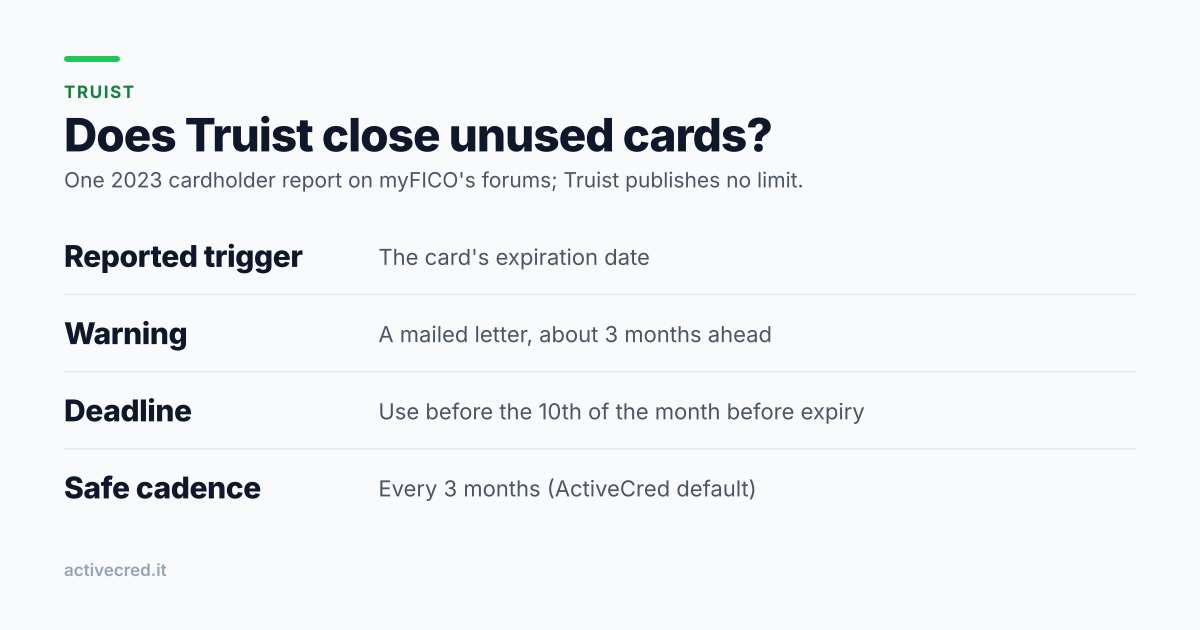
Truist is reported to close an unused credit card when it expires, and to say so by letter first. The one report on record, posted on myFICO's forums in July 2023, describes a letter about an 11-year-old SunTrust Rewards card: unless the card was used before the 10th of the month before its November 2023 expiry, the account would close on the expiration date. No report gives a number of months, and Truist's agreement says nothing about inactivity.
Truist is reported to warn by letter that an unused card will close on its expiration date unless it is used first. In the one report, the letter arrived about three months ahead. ActiveCred charges each linked card every 3 months by default, or on any schedule the cardholder chooses.
Check a Truist card or try the demoWhat the record shows
The cardholder posted on myFICO's forums in July 2023. The card was a legacy SunTrust Rewards card, 11 years old, due to expire in November 2023. The letter said the account would close on that date unless the card was used for a purchase, balance transfer or cash advance before the 10th of the month before. It arrived about three months before that deadline.
It is one report of a warning, not of a closure, and it does not say how long the card had sat unused. No report of a Truist card closed after a stated number of months was found, and Doctor of Credit's inactivity roundup does not mention Truist, SunTrust or BB&T. A 2021 myFICO thread about a closed BB&T card concerns a new account closed on activation, not inactivity. The issuer-by-issuer record shows the banks with month-based reports.
Truist was formed from SunTrust and BB&T, and many of its cards began at one or the other. The same poster says Truist would not switch the legacy SunTrust card to a different product, so a forgotten card could not be saved that way once the letter arrived. It had to be used.
What Truist's agreement says
Section 7 of the agreement (form F03-AK33-1, revised October 2022) gives Truist the right to end or suspend the account "at any time and for any reason, without notice" (Truist's card agreement). Inactivity and expiry are not mentioned. The rule about use before expiration comes from the letter, not the agreement, so Truist could apply it differently, or close a card without writing first.
No law requires the letter. Regulation B excludes actions taken because of inactivity from the rules that make lenders explain adverse decisions. A cardholder who has moved since last using the card, and not updated the address, may never see it. The notice record across banks shows how uneven warnings are.
The expiration date is the deadline
Under the letter's terms, the date on the front of the card is what matters, and the real deadline is earlier: the 10th of the month before. A card expiring in November had to be used by October 10th. The letter named a purchase, a balance transfer or a cash advance as use; a purchase is the simplest of the three.
If the card is kept, the replacement carries a new expiration date, which any merchant that bills the card will need. When a reissued card breaks every autopay covers that step.
No small-balance waiver
Some banks write off a statement balance of a dollar or two. Doctor of Credit's small-balance list, dated August 2026, records no waiver at Truist or at SunTrust. A small purchase on a Truist card will bill and needs paying. The small-balance waiver guide explains how the waivers work at banks that have them.
If a Truist card has closed
No reopening reports were found for Truist. Asking costs nothing: call, say the card was closed for inactivity, and ask whether it can be reopened as the same account. What other banks are reported to allow is in the reopening guide.
If the answer is no, a new application brings a hard inquiry and a new account with a new opening date. A closed card hits two factors worth 45% of a FICO score: amounts owed at once, and length of credit history when the account drops off the report, up to ten years later.
Checking a Truist card that has sat unused
The quickest test is a small purchase. If a $1 charge goes through and posts, the card is open and its clock has just been reset. If it is declined, the account may have been closed, or the bank's fraud checks may want to confirm the purchase; a large or unusual charge after months of silence can be refused while the account stays open.
The credit report settles whether the account is open. Reports from all three bureaus are free every week at annualcreditreport.com, and an account the bank has closed carries a remark such as "closed by credit grantor". The date of the last purchase is on the statements. Five ways to check a card sets out the rest.
Only a purchase that posts to the statement is known to reset the clock. Payments, refunds and logging in do not count. What counts as activity has the detail.
The safe cadence
With no month-based report, there is no window to halve. ActiveCred's default of every three months sits inside the shortest closure reported for any bank in its record, and puts a purchase on a Truist card well before any expiry deadline. A cardholder who picks a longer schedule should still mark the 10th of the month before the card expires.
For a card whose last purchase date is known, the inactivity checker shows how long it has been idle against the banks on record.
In short
Truist's record is one letter: use the card before the 10th of the month before it expires, or the account closes on the expiration date. Its agreement lets it close without any letter at all. A purchase every few months makes the deadline on the front of the card irrelevant.