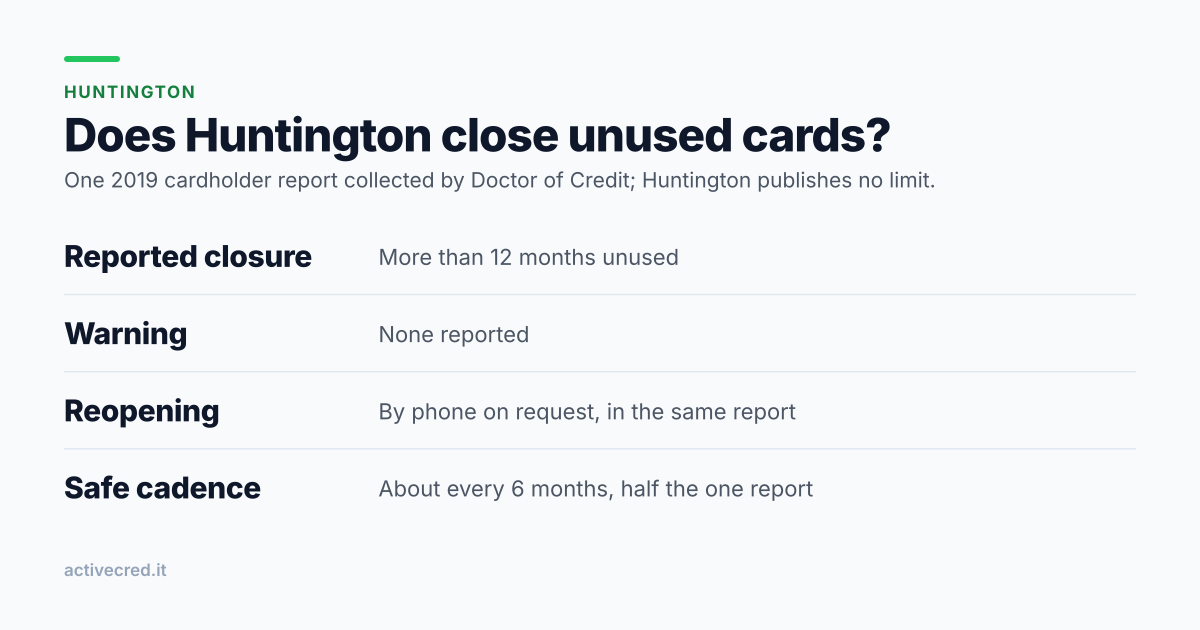
Huntington can close an unused credit card, and one cardholder says it does so after a year. That report, a 2019 reader comment collected by Doctor of Credit, says Huntington closes cards unused for more than 12 months and will reopen them on a call. It is the only data point on record, and it reads as a claim about policy rather than an account of one closure. Huntington's own card terms give no period at all.
One cardholder reports Huntington closing cards unused for more than 12 months, and reopening them by phone. No warning is reported, and Huntington's terms let it close an account without notice. ActiveCred charges each linked card every 3 months by default, or on any schedule the cardholder chooses.
Check your Huntington card or try the demoWhat the record shows
The figure comes from one comment on Doctor of Credit's inactivity roundup, posted in August 2019 by a reader who describes no dated closure of their own. ActiveCred keeps it in a public data file as a 12-month report. The article itself does not list Huntington, and none of its 114 reader comments adds a second case.
Twelve months puts Huntington among the quicker closers on record, alongside Chase, American Express and U.S. Bank. The issuer-by-issuer record has the comparison. A single comment from 2019 is a thin basis for a window, and a bank can change its practice without saying so. The figure is the best public record, not a promise.
What Huntington's terms say
The terms for the Voice card, marked accurate as of November 2026, say Huntington may close an account "at any time and for any reason", and may do so without prior notice (Huntington's Voice terms, under "Closing Your Account"). Inactivity is not mentioned, and no number of months is given.
The same terms reserve Huntington's right not to renew an account when the card expires. For an unused card, that makes the expiry date a natural point to drop it: the bank need only decline to send a new one. A purchase in the months before the date on the front of the card removes the easiest reason to let it lapse.
No warning is reported
The one report says nothing about notice, and the agreement allows Huntington to close without any. No law requires a warning either: Regulation B excludes actions taken because of inactivity from the rules that make lenders explain adverse decisions. At Huntington, the first sign of a closure may be a declined purchase. The notice record across banks shows how uneven warnings are elsewhere.
Reopening by phone
The same commenter says Huntington will reopen a card closed for inactivity if the cardholder calls and asks. No time limit is given, so a call soon after the closure is the safer course. The question to ask is whether the account can be reopened as the same account, with its original opening date, rather than as a new one. What other banks are reported to allow is in the reopening guide.
If Huntington says no, a new application brings a hard inquiry and a new account. A closed card hits two factors worth 45% of a FICO score: amounts owed at once, and length of credit history when the account drops off the report, up to ten years later.
No small-balance waiver on record
Some banks write off tiny statement balances at the close of a cycle. No such waiver is reported at Huntington: it is absent from Doctor of Credit's small-balance list and from the 1,870 reader comments under it. A small purchase on a Huntington card should be expected to bill and need paying. The small-balance waiver guide explains how the waivers work at banks that have them.
Checking a Huntington card that has sat unused
The quickest test is a small purchase. If a $1 charge goes through and posts, the card is open and its clock has just been reset. If it is declined, the account may have been closed, or the bank's fraud checks may want to confirm the purchase; a large or unusual charge after months of silence can be refused while the account stays open.
The credit report settles whether the account is open. Reports from all three bureaus are free every week at annualcreditreport.com, and an account the bank has closed carries a remark such as "closed by credit grantor". The date of the last purchase is on the statements. Five ways to check a card sets out the rest.
Only a purchase that posts to the statement is known to reset the clock. Payments, refunds and logging in do not count. What counts as activity has the detail.
The safe cadence
Half the one reported closure is about six months, so a purchase on a Huntington card every six months stays well inside the report. ActiveCred's default of every three months leaves a wider margin, which suits a record this thin. Rewards are safest redeemed before a card sits idle for long, because what happens to rewards at closure is set by the bank.
For a card whose last purchase date is known, the inactivity checker, set to Huntington shows how far into the reported window it is and the date to use it by.
In short
Huntington's record is one 2019 comment: closure after more than 12 months, no warning mentioned, and a reopening by phone. Its terms let it close any account without notice and decline to renew at expiry. A purchase every few months, and one before the card expires, keeps a Huntington card well clear of the only figure on record.