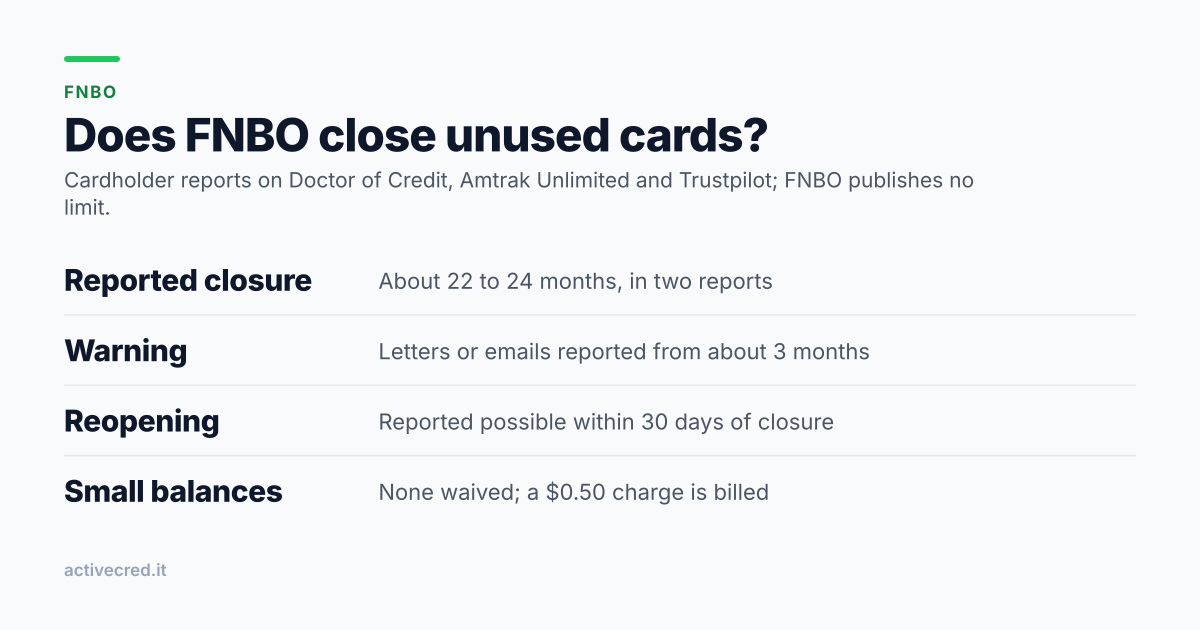
First National Bank of Omaha closes credit cards that go unused, and it often says so first. Cardholders report warning letters or emails from as early as 3 months without a purchase. Yet the two closures on record, at about 22 and about 24 months, came with no warning at all, and in both the letter arrived after the card was gone. FNBO waives no small balances, so every test charge is billed.
FNBO is reported to close unused cards at about 22 to 24 months, often after warnings that start at about 3 months. Both reported closures came without warning, and one cardholder was told the account could be reopened only within 30 days. ActiveCred charges each linked card every 3 months by default, or on any schedule the cardholder chooses.
Check your FNBO card or try the demoMany FNBO cards do not say FNBO
FNBO issues a long list of co-branded cards, among them Amtrak Guest Rewards, MGM Rewards, Scheels, Best Western and Travelite, often under the First Bankcard name. A cardholder may not know an Amtrak or MGM card is an FNBO card at all. The record below covers them.
That matters for points. Co-brand points are held by the partner, Amtrak for example, not by FNBO. In the 2023 Amtrak case the points were handled separately from the card. What happens to rewards at closure covers the general pattern.
What the record shows
Two closures have been reported. In a November 2023 thread on Amtrak Unlimited, a cardholder described an Amtrak Guest Rewards card closed after 22 months unused, with no warning beforehand and a closure letter dated 20 days after the closing. In a July 2026 review on Trustpilot, another described a card closed after about two years unused, again with no warning, and a letter saying it was already cancelled.
The 22-month figure is disputed. Another poster in the same thread pointed out that FNBO's Amtrak cards had existed for about 13 months at the time, because the card had moved to FNBO from another issuer, so part of the unused stretch may predate FNBO. A third poster said FNBO usually closes inactive cards sooner than 22 months. These are cardholder reports, not FNBO policy.
Warnings come early, but not always
FNBO is better known for warning than for closing. Readers on Doctor of Credit report:
- Letters from about month 3 onward, on a card then left until month 14 and not closed (Doctor of Credit, 2024).
- A milder reminder at 6 months (Doctor of Credit, 2020).
- An email at about 8 months saying a Travelite card would be closed if not used (Doctor of Credit, 2019).
- A warning letter at about 12 months, with no deadline (Doctor of Credit, 2019).
Doctor of Credit's own summary says FNBO warns before closing and asks for a charge on the card, a line that rests on the 2019 report. The two closures show the warning cannot be counted on. A cardholder who has had letters before may assume another will come, and on this record it may not. The notice record across banks has the comparison.
What the agreement says
FNBO's cardmember agreement, filed with the Consumer Financial Protection Bureau, lets the bank close the account or suspend new transactions at any time and for any reason, and without notice beforehand (section 14). It does not mention inactivity and gives no period. The right to close without warning is the clause the two closures fit.
If an FNBO card closes, call at once
In the 2023 Amtrak Unlimited thread, FNBO staff are reported to have said that accounts can be reopened within 30 days of closure. That cardholder asked at 32 days, because the closure letter had arrived late, and was refused. FNBO reopened the card in January 2024, after the cardholder complained to a federal regulator.
The lesson is timing. The closure letter can arrive with most of the 30 days already gone, so a declined card is the signal to call, not the letter. What other banks are reported to allow is in the reopening guide.
No small-balance waiver
Many banks credit a statement balance of a few cents at cycle close. FNBO does not. Doctor of Credit's list says "FNBO Omaha" has none, and readers have confirmed it repeatedly from 2016 to September 2026, across an FNBO Amex, a Best Western business card, MGM Rewards and Amtrak cards, with $0.50, $0.99 and $1 charges billed. A small charge on an FNBO card has to be paid, and ActiveCred's charges on FNBO cards are billed in full. The small-balance waiver guide lists the banks that do credit them.
Checking an FNBO card and the safe cadence
The quickest test is a small purchase. If it posts, the card is open and its clock has restarted. If it is declined, the account may be closed, or fraud checks may want to confirm the purchase. FNBO's website or app, or the partner's card page, shows a closed account as closed, and so does the credit report. Only a posted purchase is known to reset the clock; what counts as activity has the detail.
Half the shortest reported closure is about 11 months. Because that report is disputed, and FNBO warns from 3 months, ActiveCred's issuer data suggests 182 days between purchases on an FNBO card instead, and ActiveCred's own default is every 3 months. The inactivity checker, set to FNBO, shows how far into the reported window a card is.
In short
FNBO writes early and closes late, but not every closure is preceded by a letter, and the 30-day window to reopen can be half gone before the closure letter lands. With no small-balance waiver, a purchase on an FNBO card costs its face value. Using the card well inside the record, and calling the day it is declined, is what the reports support.