Elan Financial Services, a division of U.S. Bank, closes credit cards that go unused, and it seldom says so first. Two cardholder reports collected by Doctor of Credit describe closures at about four years without a purchase, both without a warning. Elan's own card agreement lists an inactive account as a default that allows cancellation without notice. Because Elan issues the Fidelity Rewards Visa and cards for many local banks and credit unions, plenty of its cardholders do not know they are its customers.
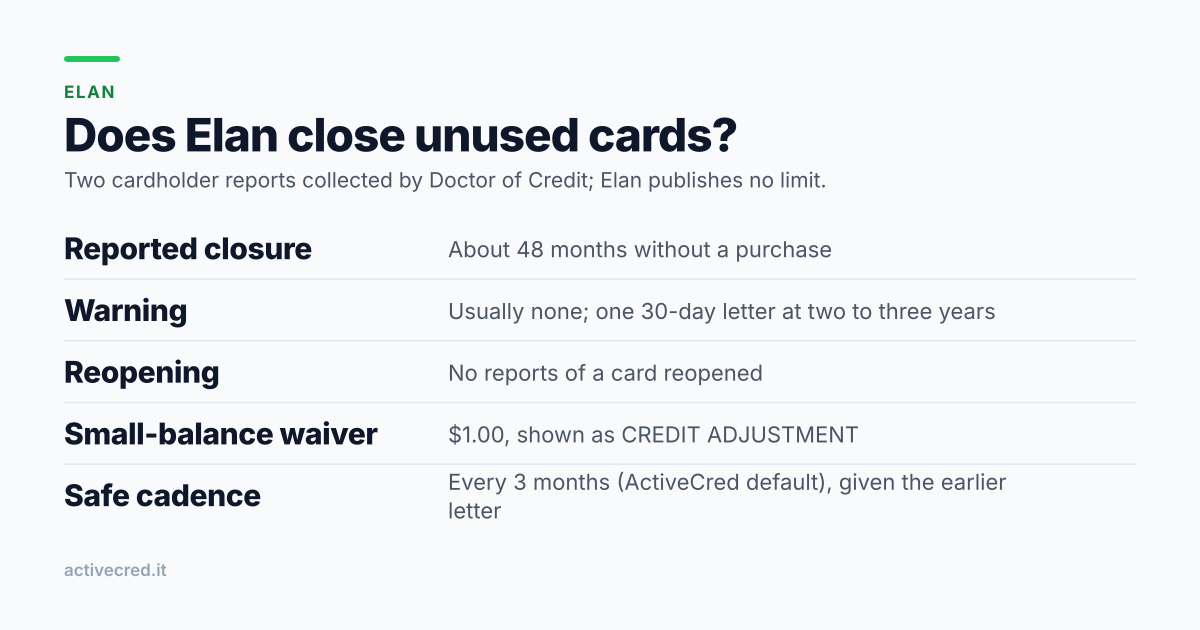
Elan is reported to close an unused card at about four years, usually with no warning. One cardholder got a 30-day letter after two to three years, and no one reports a card being reopened. ActiveCred charges each linked card every 3 months by default, or on any schedule the cardholder chooses.
Check your Elan card or try the demoWhat the record shows
Two dated reports carry the figure. In February 2021 a reader told Doctor of Credit that an Elan card was closed after 48 months unused, with no warning letter. In December 2021 another reader found a Fidelity card gone on logging in, after almost four years unused, again with no warning. These are cardholder reports, not Elan policy, and both are now five years old.
Other reports show Elan acting before four years without closing. A Comerica Bank card issued by Elan drew a letter giving 30 days to make a purchase after two to three years unused. One Fidelity cardholder received a mailed notice cutting the limit to 10% of its former level after about three years. Another card was reissued after more than two years unused, with no closure.
The figures sit in ActiveCred's public data file, checked on November 26, 2026. Elan's shortest report, four years, is the longest of any bank in it; the issuer-by-issuer record has the comparison. The letter at two to three years matters more than the headline figure, because it shows closure could come at about 25 months.
The agreement names inactivity
Most card agreements say a bank may close an account at any time. Elan's goes further. Section 27 of both its general and its Fidelity agreements, filed for the second quarter of 2026 with the Consumer Financial Protection Bureau, lists among the events of default: "your Account becomes inactive".
Section 31 then lets Elan cancel immediately and without notice when an account is in default. The agreement does not define "inactive" or give a period. In practice that means the contract allows a closure with no letter at all, which is what both four-year reports describe.
One issuer, many names
Elan runs credit cards for banks that do not issue their own. The Fidelity Rewards Visa Signature is the best known; readers also name Comerica, People's United, Lake City, Renasant and South State. The card may carry the partner's name, while the account, the agreement and the inactivity rules are Elan's.
Partner banks add their own wrinkles. One 2025 myFICO thread reports a Renasant card issued by Elan closed while in regular use, with posters guessing at a deposit-account requirement at that bank. That was not an inactivity closure, and its cause is unconfirmed. A 2016 myFICO report describes a card closed on July 1, 2016, around the time Fidelity's cards moved to Elan, even though Elan had said by phone a year earlier that it did not close cards for non-use.
Because Elan is part of U.S. Bank, how U.S. Bank treats its own cards is a useful comparison, though the record for each is separate.
The $1 waiver, and the month it fails
Elan usually writes off a statement balance of $1.00 or less, shown as CREDIT ADJUSTMENT. Fidelity cardholders have reported it on Doctor of Credit since 2020, and as recently as October 2026, when one reader saw $1.00 waived on the 15th. The ceiling is $1: a balance of $1.96 was not waived in March 2026.
One month a year it fails. Many readers report no waiver in the card's anniversary month, when Elan posts a $0 "ANNUAL MEMBERSHIP FEE" line. On the Fidelity card that line often does not appear on the mailed statement, but the miss still happens. Scattered misses in other months, including three in a row for one reader in August 2026, mean the waiver is usual, not certain. A small charge in the anniversary month is a real bill.
Readers also say Elan reports the balance to the bureaus on the last day of the month, not the statement date, so a $1 charge can show on the credit report before the waiver posts. The small-balance waiver guide covers how waivers work at other banks.
If the card has already closed
No reports were found of Elan reopening a card closed for inactivity. In a 2019 myFICO account, a Fidelity cardholder spoke to a representative, a supervisor and that supervisor's supervisor, and all said nothing could be done. About 200,000 points were forfeited. That closure followed an information request the cardholder says never arrived, so it was not inactivity alone, but it shows how little room there is afterward.
Asking costs nothing, and what other banks are reported to allow is in the reopening guide. Rewards are the larger loss: points on a Fidelity card should be redeemed before the card is left to sit, and the rewards guide explains what happens to them at closure. A closed card hits two factors worth 45% of a FICO score: amounts owed at once, and length of credit history when the account drops off the report, up to ten years later.
Checking an Elan card that has sat unused
The quickest test is a small purchase. If it posts, the card is open. If it is declined, the account may be closed, or the bank's fraud checks may want to confirm the purchase. Elan's website or app shows a closed account as closed; one Fidelity cardholder learned of a closure only by logging in.
The credit report settles the question. Reports from all three bureaus are free every week at annualcreditreport.com. The 2016 closure above was reported as "closed by consumer", so a remark that looks wrong is worth disputing; the difference between the two remarks is explained separately. Mail from Elan deserves an answer, since one closure followed an unanswered request for information.
The safe cadence
Half the shortest reported closure at Elan is about 24 months. That figure needs care: a warning letter at two to three years means a card used only every two years could be closed first. ActiveCred's default, a charge every three months, sits well inside every Elan report, and a cardholder can choose a longer interval for a card where the four-year record seems enough.
For a card whose last purchase date is known, the inactivity checker, set to Elan, shows how far into the reported window it is.
In short
Elan gives more time than most banks, about four years in the reports, and less warning. Its agreement allows a closure without notice, nobody reports a card coming back, and Fidelity points go with the account. The long window is a reason for an occasional purchase, not for none.