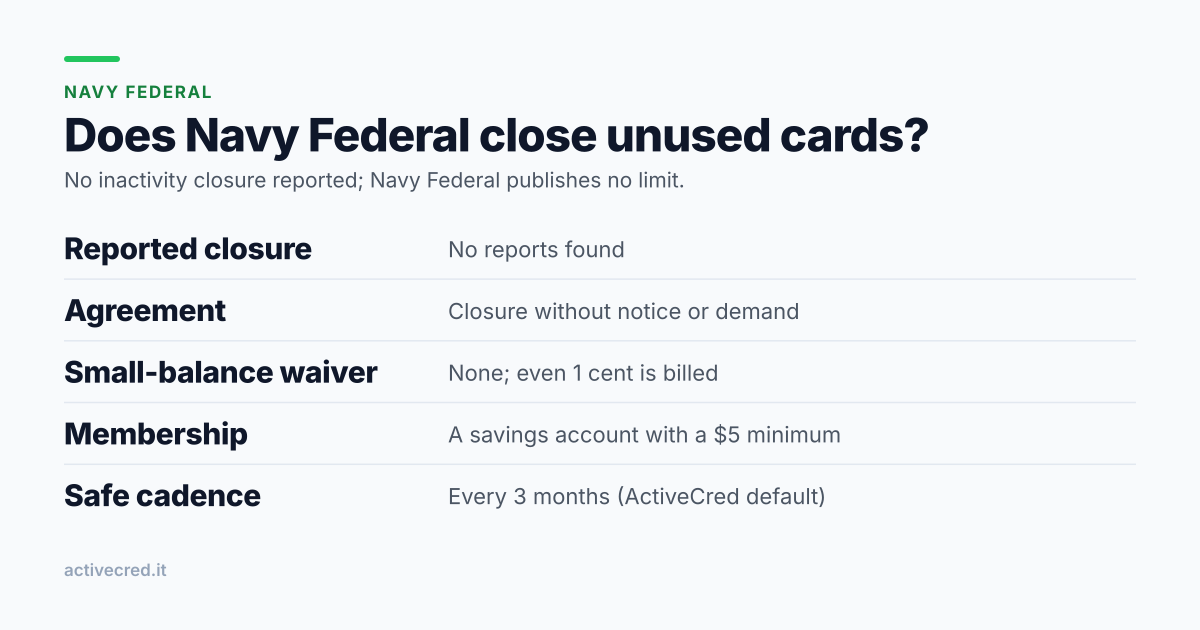
Navy Federal Credit Union publishes no inactivity period for its credit cards, and ActiveCred found no credible report of one closed for inactivity. Its card agreement lets it close an account without notice. Two things set it apart from the large banks: it waives no small balance, so every charge is a bill to pay, and membership rests on a savings account with a $5 minimum.
No Navy Federal credit card is reported closed for inactivity, and the agreement allows closure without notice. Navy Federal does not waive small balances, so a small charge is billed and must be paid. ActiveCred charges each linked card every 3 months by default, or on any schedule the cardholder chooses.
Check a Navy Federal card or try the demoWhat the record shows
The search came back empty. Doctor of Credit's inactivity article does not mention Navy Federal, and neither do any of its 114 comments. A myFICO thread from November 2021 asked how long PenFed and Navy Federal wait before closing unused cards and drew no data points.
A second myFICO report, from September 2021, describes a Navy Federal cash rewards card that was not reissued at expiry and was closed. That card carried a high balance; it was not unused, so it is not an inactivity case. A figure on one undated website cites no source and is not used here.
The inactivity rules Navy Federal does publish cover GO Prepaid cards, gift cards and deposit accounts, not credit cards. Reddit could not be searched, so reports may exist there. An empty record is not proof that Navy Federal never closes an idle card.
What the agreement says
The card agreement, form 573CC dated February 2026 and filed in the Consumer Financial Protection Bureau card agreement database, says: "We may, without notice or demand, close your account." It does not mention inactivity or give a period. It also lets Navy Federal cancel a card and issue a substitute at any time.
So no warning is promised. With no inactivity cases on record, there is no evidence either way on whether letters go out in practice.
No small-balance waiver
Several large banks forgive a statement balance of a dollar or two. Navy Federal is reported not to. Doctor of Credit lists it as having no waiver, and readers' comments from 2018, 2022 and 2026 report 99-cent and even 1-cent balances billed. One put it simply: "NFCU does not forgive."
That reader first thought the balance had been waived, because the statement showed no minimum payment due. It had not. For a scheduled charge, the arithmetic is plain: every charge on a Navy Federal card is a real bill and needs paying like any other. The small-balance waiver guide explains how waivers work at the banks that offer them.
Membership and the savings account
Navy Federal is a credit union, and a card is one product of a membership. Its membership FAQ says a Membership Savings Account with a $5 minimum balance is required to establish and keep membership.
The Navy Federal fee schedule adds an inactive member fee of $3.00 a quarter on a share savings account holding under $50 with no activity for 12 months, for members over 24. Members with other products are excluded. A credit card probably counts as another product, but the page does not say so outright.
Deposit accounts can close too. One reader on Doctor of Credit says Navy Federal closed deposit accounts opened in boot camp, without notice, after they sat unused. That report concerns deposit accounts, not cards.
Checking a Navy Federal card that has sat unused
The quickest test is a small purchase. If a $1 charge posts, the card is open and its clock has reset. If it is declined, the account may have been closed, or the bank's fraud checks may want to confirm the purchase. Navy Federal's app or website shows a closed account as closed.
The credit report settles whether the account is open. Reports from all three bureaus are free every week at annualcreditreport.com, and an account the bank has closed carries a remark such as "closed by credit grantor". Five ways to check a card sets out the rest.
Only a purchase that posts to the statement counts as use. Payments, refunds and logging in do not reset the clock, and a balance transfer is not a purchase. What counts as activity has the detail.
If a Navy Federal card closes
No reopening reports exist for inactivity closures. In the 2021 high-balance case above, representatives said the account could not be reconsidered once closed and the member would have to apply again. That is one account, closed for a different reason. Asking costs nothing, and what other banks are reported to allow is in the reopening guide.
A new application brings a hard inquiry and a new account with a new opening date. A closed card hits two factors worth 45% of a FICO score: amounts owed at once, and length of credit history when the account drops off the report, up to ten years later. How a closed account ages on the report explains the second part.
A sensible cadence
With no reported closure to measure against, there is no figure to halve. ActiveCred's default is every 3 months, which is inside the shortest closure reported for any bank in its issuer data file. The cardholder can set a longer or shorter schedule for each card. This is general information about what is on record, not advice about a particular account.
Because Navy Federal waives nothing, each scheduled charge appears on the bill and is paid like any purchase. The inactivity checker, set to another bank or credit union, dates the next purchase on the 3-month default.
In short
Navy Federal's record holds no inactivity closures, an agreement that allows closure without notice, and a firm habit of billing every cent. The quiet record is a gap in evidence, not a promise. A purchase that posts every few months, paid in full, is the use the credit union can see.