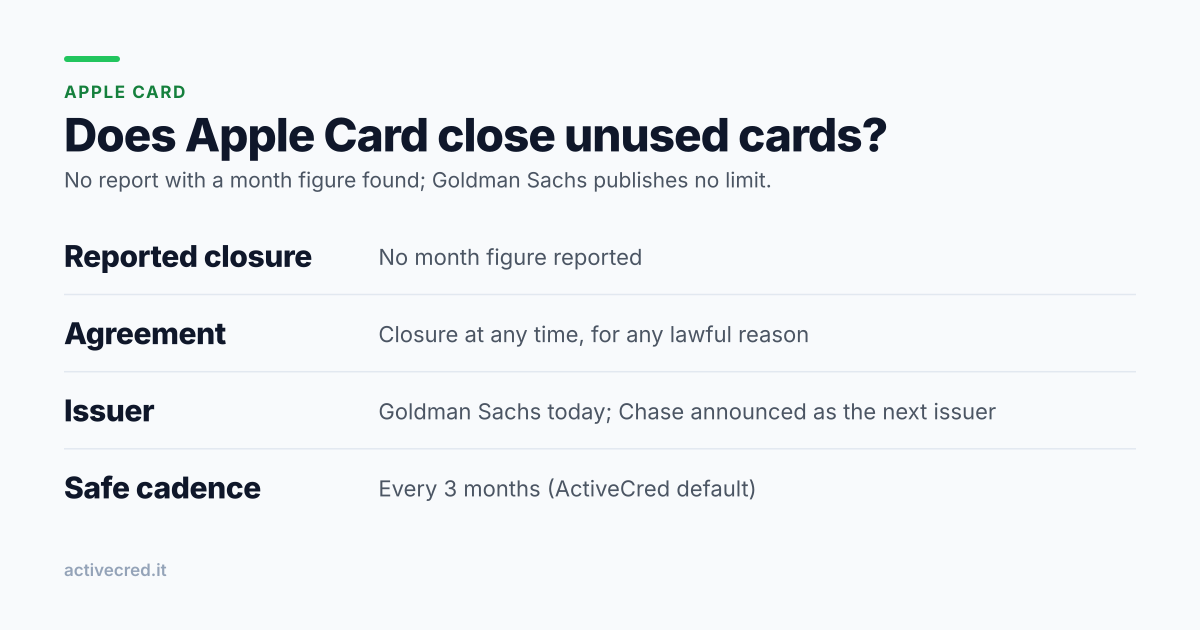
Apple Card has no published inactivity rule, and ActiveCred found no report of an inactivity closure with a month figure. Goldman Sachs issues the card today, and its agreement lets the bank close an account at any time for any lawful reason. Chase has agreed to become the issuer, with completion expected about two years after its January 2026 announcement. With so little on record, ActiveCred's default of a purchase every 3 months is the reference point.
No Apple Card inactivity closure with a month figure has been reported, and Goldman Sachs publishes no limit. ActiveCred charges each linked card every 3 months by default, or on any schedule the cardholder chooses.
Check an Apple Card or try the demoWho issues Apple Card
Goldman Sachs Bank USA issues and services Apple Card, according to Apple. On January 7, 2026, JPMorgan Chase announced that Chase will become the new issuer. The release says completion is "not anticipated for approximately 24 months" and needs regulatory approval. That points to about January 2028, with no firm date.
The card stays on Mastercard. Cardholders need do nothing for now, and Goldman handles support until the move is complete. Afterward, credit reports will show Chase as the issuer. Apple's FAQ says card numbers and new cards will be addressed later, "if applicable".
Chase's own record in ActiveCred's data runs from 12 to 24 months, and the 12-month reports involve a card that was expiring and was not reissued. That says nothing yet about how Chase will treat an idle Apple Card. How Chase treats its own cards has the detail.
What the record shows
The record is thin. ActiveCred found no report with a month figure for an Apple Card inactivity closure at Doctor of Credit, NerdWallet, Bankrate or The Points Guy, and Doctor of Credit's inactivity list does not include the card. An empty record is not proof that Goldman Sachs never closes an idle card.
A volunteer on the same forum once offered a general range of months for closures. That is a guess about policy, not a report of a closure, and it is not used here.
What the agreement says
The Goldman Sachs agreement, under "Suspending or Closing Your Account", says the bank may close the account "at any time and for any reason permitted under applicable law". It does not mention inactivity and gives no period. It promises no warning either, and the one cardholder report does not mention one.
The agreement also limits use of the account for a cardholder who does not keep a Required Device, an iPhone, iPad or Vision Pro that supports Apple Card in Wallet. It does not say the account closes for that reason. Apple Card has no annual fee, so nothing posts to the account each year on its own; a fee would be no substitute for a purchase in any case.
The small-balance waiver
Doctor of Credit, in a page updated August 10, 2026, says Apple Card and other Goldman cards waive "$.99 and possibly even $1". It names no statement line, and no cardholder report of one was found. The agreement itself has no small-balance clause.
If the waiver works as described, a statement balance that small is forgiven rather than billed. The purchase has already posted by then, and only a posted purchase is known to reset an inactivity clock. The small-balance waiver guide covers how that works. Without the waiver, a small charge is simply a small bill to pay.
Checking an Apple Card that has sat unused
The account is built around Apple Wallet: the cardholder applies, manages and pays there or at card.apple.com, which show the account's state. A titanium physical card exists, and a small charge reaches the account through the card number or Apple Pay like any Mastercard purchase. The quickest test is a $1 purchase. If it posts, the account is open and its clock has reset; if it is declined, the account may be closed, or a fraud check may want to confirm the purchase.
The credit report settles whether the account is open. Reports from all three bureaus are free every week at annualcreditreport.com, and an account the bank has closed carries a remark such as "closed by credit grantor". Today the account is reported under Goldman Sachs; after the move it will show Chase. Five ways to check a card sets out the rest.
Only a purchase that posts to the statement counts as use. Payments, refunds and logging in do not reset the clock, and a balance transfer is not a purchase. What counts as activity has the detail.
If an Apple Card closes
No reinstatement window is reported, and Apple's page on closing an account says nothing about reopening. Asking costs nothing, and what other banks are reported to allow is in the reopening guide.
A new application brings a hard inquiry and a new account with a new opening date. A closed card hits two factors worth 45% of a FICO score: amounts owed at once, and length of credit history when the account drops off the report, up to ten years later. How a closed account ages on the report explains the second part.
A sensible cadence
With no reported closure to measure against, there is no figure to halve. ActiveCred's default is every 3 months, which is inside the shortest closure reported for any bank in its issuer data file. The cardholder can set a longer or shorter schedule for each card. This is general information about what is on record, not advice about a particular account.
The issuer change argues for a margin. A new bank may bring new practices, and Apple has said card numbers will be addressed later. A scheduled charge set up on a number that changes will fail, so the schedule is worth checking when Chase takes over. When a reissued card breaks every autopay covers that problem. The inactivity checker, set to another bank or credit union, dates the next purchase on the 3-month default.
In short
Apple Card's record holds one unconfirmed report and an agreement that allows closure for any lawful reason. The issuer is changing, and nobody yet knows what Chase will do with an idle Apple Card. A purchase that posts every few months is the use either bank can see.