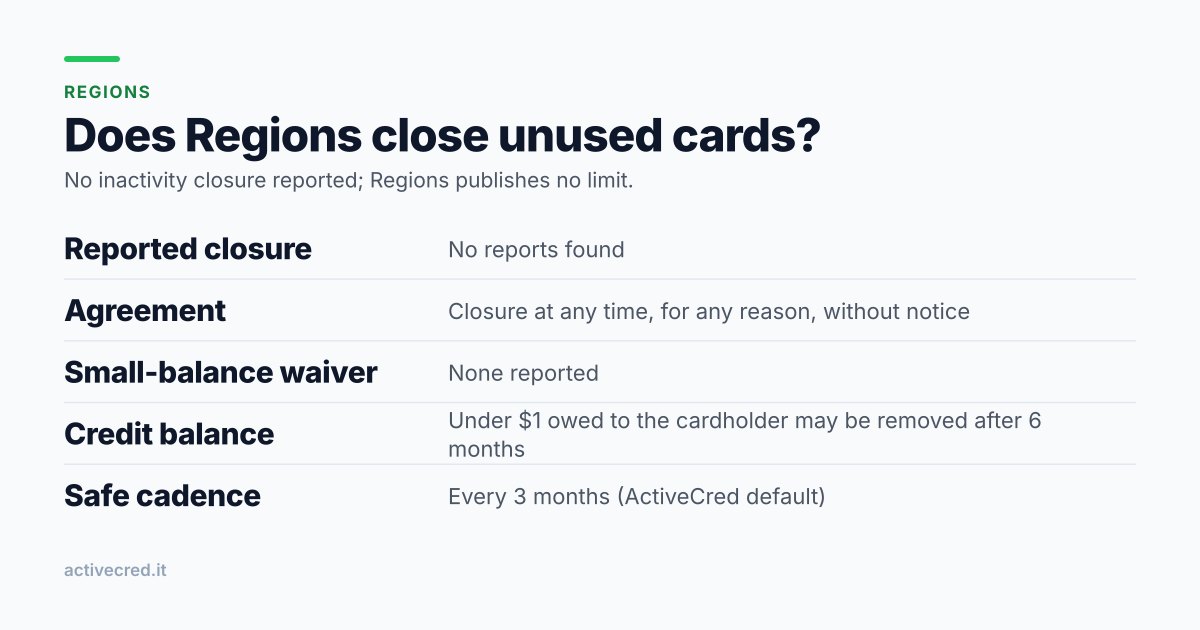
Regions Bank publishes no inactivity period for its credit cards, and ActiveCred found no report of one closed for inactivity. Its unsecured card agreement lets it close an account at any time, for any reason, and without first notifying the cardholder unless the law requires it. The agreement has no small-balance waiver. Its under-$1 clause concerns a credit balance, which is money Regions owes the cardholder.
No Regions credit card is reported closed for inactivity, and the agreement allows closure without notice. No small-balance waiver is reported, so a small charge is billed and must be paid. ActiveCred charges each linked card every 3 months by default, or on any schedule the cardholder chooses.
Check a Regions card or try the demoWhat the record shows
The search came back empty. ActiveCred read Doctor of Credit's inactivity post and all 114 of its comments, every Doctor of Credit comment that mentions Regions, and Regions' own help pages on credit cards and Relationship Rewards. None reports a Regions card closed for inactivity.
An empty record is not proof that Regions never closes an idle card.
What the agreement says
The unsecured card agreement, marked "Rev. 7.17.2025" and filed with the Consumer Financial Protection Bureau, says under "Authorizing Transactions/Suspending and Closing your Account" that Regions may suspend or close the account "at any time, for any reason". Unless the law requires otherwise, it need not notify the cardholder first. Inactivity is not mentioned and no period is given.
Regions also files a Wealth agreement and an Explore secured agreement. This guide rests on the unsecured one only, so cardholders on those cards should read their own terms.
The under-$1 clause is not a waiver
Some banks forgive a small balance the cardholder owes. Regions is not on Doctor of Credit's list of banks that do, and no cardholder reports one. A 2019 reader on that page asked about Regions cards and got no recorded answer.
The agreement does contain a clause about sums under $1, but it runs the other way. It covers a credit balance, which is money Regions owes the cardholder, for example after an overpayment. A credit balance of less than $1 that has sat on the account for at least 6 months may be removed automatically. That forfeits the cardholder's money; it does not waive anything the cardholder owes.
Two things follow. A small charge on a Regions card is billed and must be paid in full. And a cardholder who overpays by a few cents and then stops using the card may lose those cents after 6 months. The refund clock on a credit balance explains how credit balances are handled more widely.
Rewards stop at closure
Regions says that if a Relationship Rewards credit card is closed for any reason, by the cardholder or by the bank, it stops earning points. Redeeming points while the card is open settles what happens to them. What happens to points at closure covers other banks.
Checking a Regions card that has sat unused
The quickest test is a small purchase. If a $1 charge posts, the card is open and its clock has reset. If it is declined, the account may have been closed, or the bank's fraud checks may want to confirm the purchase. Regions' app or website shows a closed account as closed.
The credit report settles whether the account is open. Reports from all three bureaus are free every week at annualcreditreport.com, and an account the bank has closed carries a remark such as "closed by credit grantor". Five ways to check a card sets out the rest.
Only a purchase that posts to the statement counts as use. Payments, refunds and logging in do not reset the clock, and a balance transfer is not a purchase. What counts as activity has the detail.
If a Regions card closes
No reopening reports exist. Asking costs nothing, and what other banks are reported to allow is in the reopening guide. A new application brings a hard inquiry and a new account with a new opening date.
A closed card hits two factors worth 45% of a FICO score: amounts owed at once, and length of credit history when the account drops off the report, up to ten years later. How a closed account ages on the report explains the second part.
A sensible cadence
With no reported closure to measure against, there is no figure to halve. ActiveCred's default is every 3 months, which is inside the shortest closure reported for any bank in its issuer data file. The cardholder can set a longer or shorter schedule for each card. This is general information about what is on record, not advice about a particular account.
With no waiver reported, each scheduled charge appears on the bill and is paid like any purchase. The inactivity checker, set to another bank or credit union, dates the next purchase on the 3-month default.
In short
Regions' record holds no inactivity closures and an agreement that allows closure at any time without notice. Its one small-sum clause takes the cardholder's credit balance; it forgives nothing owed. A purchase that posts every few months, paid in full, is the use the bank can see.