Closing a credit card rarely helps a FICO score and usually costs it something. The cost arrives in two steps. The first comes within a statement cycle or two: the card's limit leaves the total, so the same balances count as higher utilization. The second can come a decade later, when the closed account drops off the report and takes its age with it. Neither step depends on who closed the card, so an unused card closed by the bank costs as much as one closed by its owner.
Usually, yes. Utilization rises as soon as the closed limit leaves the total; amounts owed are 30% of a FICO score. The account's age keeps counting for up to ten years, then drops off with it. myFICO says it never recommends closing old or unused cards to raise a score. The same applies when the bank closes an idle card. ActiveCred puts a small charge on each card a cardholder picks, so an unused card shows activity; it does not raise a score.
See how the charges work or jump to pricingStep one: utilization rises at once
Utilization is balances divided by limits, measured across all revolving accounts and on each card separately. It falls under amounts owed, which is 30% of a FICO score. Closing a card removes its limit from the sum and leaves the balances where they were.
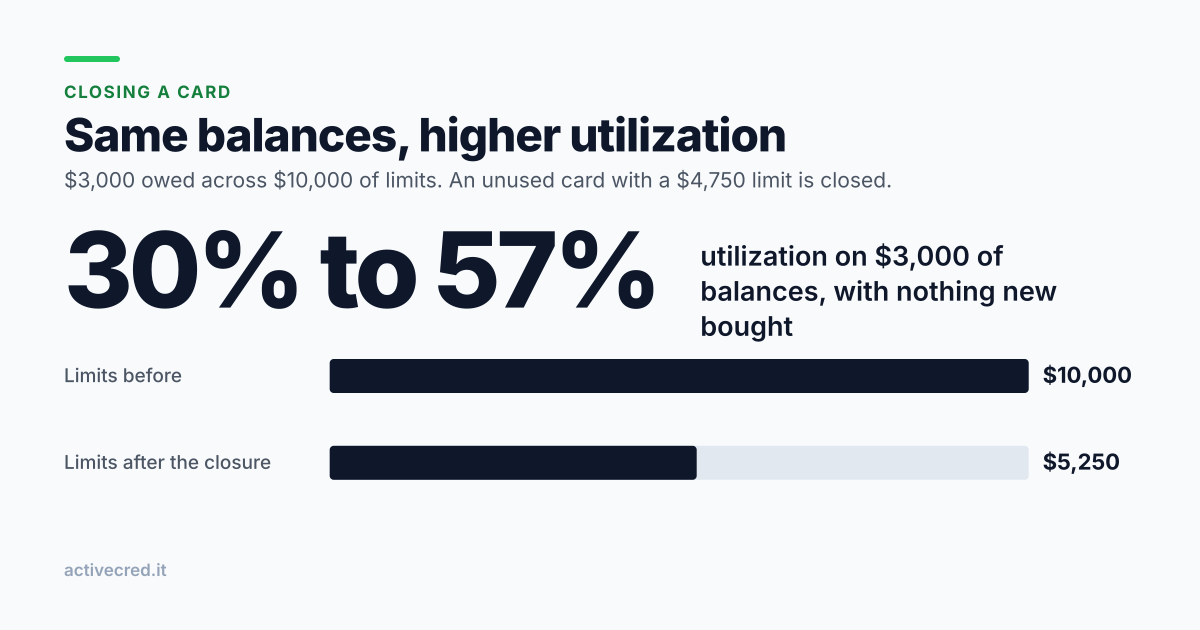
Take a cardholder with $3,000 of balances spread over $10,000 of limits. Utilization is 30%. An unused card with a $4,750 limit is closed. The same $3,000 now sits against $5,250 of limits, and utilization is 57%. Nothing was bought. myFICO uses an example of the same shape, and concludes that closing old or unused cards rarely helps.
The rise shows when the cards next report, usually on each statement date. It is also reversible: utilization has no memory in FICO's widely used models, so paying balances down undoes it at the next report. A cardholder with no balances at all loses nothing on this step. Most cardholders carry some balance between statements, so most do.
Step two: the age goes later
Length of credit history is 15% of a FICO score. It looks at the age of the oldest account, the newest, and the average. A card closed in good standing does not leave that calculation when it closes. It stays on the report, and in the average, for up to ten years, according to Experian.
The delay hides the cost. When the closed account finally drops off, the oldest card on the file can go with it, often years after its owner has forgotten it. On a thin file the effect is largest: a first card that was opened a decade before the others carries much of the average by itself. How long closed accounts stay on a report sets out the timing.
How much a closure costs in points
FICO does not publish point values for any change, and the answer depends on the rest of the file. Three things set the size of the hit:
- The card's share of total limits. Closing a $500 card on a file with $40,000 of limits barely moves utilization. Closing the largest limit can double it.
- The balances carried. With $0 reported on every card, utilization stays at 0% whatever closes.
- The card's age relative to the others. This matters only later, when the account drops off, and most on a file with few accounts.
When the bank closes it instead
Banks close cards that go unused. No US issuer publishes its limit; cardholders report closures from about 10 months without a purchase at Wells Fargo to two years or more at Citi and Bank of America. The effect on the score is the same as a voluntary closure. The difference is timing, because a bank's closure arrives without the owner choosing it, sometimes in the months before a mortgage or car loan. The report notes that the credit grantor closed it; what that remark means is covered separately.
Payments and a zero balance do not count as use. What the inactivity review looks for is a posted purchase, of any size, every few months.
When closing still makes sense
There are real exceptions. An annual fee the cardholder no longer wants to pay, with no fee-free version to move to. A joint account after a relationship ends. A card that tempts its owner into debt. Before closing for a fee, it is worth asking the bank for a product change: moving to a no-fee card on the same account keeps its history and its limit. When closing a card makes sense works through each case, and dropping an annual fee without losing the account covers the downgrade.
In short
A closed card costs a score twice: once in utilization, quickly and reversibly, and once in age, slowly and for good. A card that costs nothing to keep is usually worth keeping open, and an open card nobody uses needs a small purchase now and then, or the bank may close it anyway.